Showing posts with label Carmine Infantino. Show all posts

The Puzzling Prophecies of the Tea Leaves!

So, it's been a second. One thing that's happened is I got a new job that drastically changed my day to day schedule, so that's one thing I've had to adjust to. Plus, there's a pandemic going on and there was an election and a lot to think over. Shout out to my friend Sean who's currently quarantining after a positive test. Admittedly, the Hartley Sawyer news was also a buzzkill. (They've announced that Ralph will be leaving the show, his farewell episode will see him replaced with another actor, so there won't be many more TV reviews when the show comes back in February. Hopefully his reception on the show gets them to adapt the character in other ways. It's just a shame that once we get the start of Ralph and Sue, it's over.)

Anyway, on to Detective Comics #353 which is available on Comixology and DC Universe.

In the letters page, only a couple readers wrote in to weigh in on Ralph. Alan Trahern of Covington, Louisiana wrote that "The 13 O'Clock Robbery" was "excellent, as usual. I always enjoy reading (Ralph's) yarns and love his tricky tactics that he uses in winding up his capers." Ingrid Nurenberg of Woodland Hills, California says that Ralph is "groovy! I luv the way he stretches—but how does he do it? I can almost understand getting his cells (muscle-wise) to stretch, but what about his bones?"

"The Puzzling Prophecies of the Tea Leaves!" was written by Gardner Fox and drawn by Carmine Infantino with lettering by Gaspar Saladino with Julius Schwartz as editor.

The Splash page sees Ralph creeping through a keyhole and wrapping up a couple crooks with his stretchy arms, thinking how he was informed about the crime and his involvement by a fortune teller. An interesting note is that there's a clear artist credit, unusual, but Infantino deserved it.

The text says this takes place in Quaker City, which is the name of a village in Ohio and a community in Pennsylvania. Most likely, as usual, this is supposed to be "Any Metropolitan City, USA," but it's always fun to see if it matches up to any actual places.

So, we kick off with Sue having her fortune told. Sue doesn't believe in it, but thinks it's fun as the teller warns her that she is "destined to take a fall," and that "an ominous voice will greet you when you return home!"

While walking an hour later, a heel on one of Sue's shoes breaks, making her fall, but Ralph is nearby and grabs her before she hits the ground, his jacket ripping in the process. She explains the fortune teller's prophecy, but Ralph dismisses it.

However, when they arrive at their hotel room, they hear the promised ominous voice saying "They say nothing ever happens in Quaker City—but beware!" Ralph slips out of his jacket, which Sue collects and notes the rip in it. She says she'll mend it.

Okay, we're supposed to believe that Sue mends Ralph's clothes? I'm not saying she wouldn't know how, but given they're a rich couple, couldn't they drop it off at a tailor's instead? But then, it's nice to know Sue's helping Ralph out somehow.

Infantino is in his usual pencil and inking style and doing all right. He's able to detail action well, even if it's not looking as good as when Sid Greene handled inking.

Ralph laughs when he discovers that the ominous voice is coming from a mynah bird that was delivered to their room, however, when questioned, the manager says that he was told Sue ordered the bird. Ralph decides to question the fortune teller himself and finds her telling a widow that she'll receive $100,000 in the mail tomorrow.

Ralph asks the teller about the mynah bird, and she protests that she can indeed read the tea leaves, and she tells him that he'll stop three men attempting a robbery at 10 o'clock that night at the Loftus Jewel Salon.

Ralph decides not to go so as not to give the fortune teller the satisfaction, especially as he and Sue have theater tickets. However, Sue can tell that Ralph is thinking of the prediction as his nose keeping twitching and growing longer. When it reaches into the piled up hairdo of the woman sitting ahead of him, Sue finally tells Ralph to go look into the robbery.

Ralph goes to the jewelry store and indeed finds two (not three) robbers inside. He surprises them by wrapping them up with his arms, then socking them in the jaw, then knocking their heads together. Turning them over to the police, Ralph decides to go see the fortune teller again, thinking that she might actually be the ringleader of the robbers, but he finds two more trying to rob her.

Ralph knocks these two out with a safe. Which would probably really hurt someone. Then he smacks them together as Ayda the fortune teller comes downstairs.

Ralph questions Ayda, who reveals her real name is Alice Avery, the daughter of the late Andrew Avery, a ruthless businessman who legally took advantage of people, including Ralph. Alice has been using the guise of Ayda to make restitution to people he wronged. She was actually mailing the $100,000 to the widow she was talking to earlier.

As for Ralph, she knew he didn't need financial compensation, so she offered him a mystery to investigate. She arranged the mynah bird and noting Sue's shoes, predicted the fall. She overheard the crooks talking about their plans to rob the jewelry store, so sent Ralph on their trail.

Ralph declares that he's been repaid with interest.

Ralph meets up with Sue in their hotel room, and they say that Quaker City is a "fun town" now. Sue can be seen mending Ralph's jacket in the final panel.

Overall, not a bad story. It's just not very memorable. Gardner Fox wrote an okay story without many logic leaps, and Infantino is doing good but not great work here.

Next time, jewel thieves.

The Counter of Monte Carlo!

Detective Comics #352 has a cover date of June 1966 and is available on Comixology and DC Universe.

Over in the letters page, two readers write in that Ralph should get a chance to grace the cover of the comic sometime. (If you're wondering, it doesn't happen. Ralph would appear on the cover, but only alongside other characters with Batman up front.)

Mickey Gaither of Ellicott City, Maryland suggested that Ralph could be featured on the cover or split the cover with Batman. But before that, he comments on "My Wife, The Witch!" saying it was an entertaining story, "not 'The best story I've ever read' as some of your readers might try to tell you. I'd like to congratulate you on the job you've done with the Elongated Man strip; at first I thought it held no promise because of Ralph's power, probably the most common in all comicdom. Sue does add much to this success, along with the idea of a married, secret-identityless superhero."

He goes on with "Lastly, why not feature the Elongated Man on a cover? Or perhaps a cover divided into two, with him AND Batman?"

Irene Vartanoff of Bethesda, Maryland hits the same note with a more impassioned plea: "Dear Editor: How about featuring Elongated Man on the cover of Detective? I feel that, since the title of the mag is Detective, NOT Batman, the Elongated Man has just as much right to the cover as Batman has. The Martian Manhunter never had a chance when he appeared in Detective, to my sorrow, and he was always considered 'inferior' because of it. (This is an unconscious reasoning; the reader feels that the unfeatured story is a 'filler'). Please give Elongated Man a chance. I'm sure you'll never regret it."

Well, as above stated in a parenthesis, Ralph didn't get a starring cover in Detective Comics. The reason is simple: Batman was the iconic character for DC, and was soon appearing on TV screens. With so much media presence, they wanted to sell the most copies. However, despite not featuring on Detective Comics' cover, Ralph was amassing fans who loved the character.

Julius Schwartz asks readers to sound off on the idea of featuring Ralph on the cover. We'll see if this resumes in a few issues' time.

"The Counter of Monte Cristo!" was written by Gardner Fox with Carmine Infantino on pencils and inks while Gaspar Saladino lettered and Julius Schwartz served as editor.

Splash page time! The text teases that Ralph is lured into yet another adventure as he and Sue visit Monte Carlo. The panel shows Ralph rapidly swinging back and forth to draw the fire of three gunmen, trying to use up their ammunition. It's a pretty eye-popping splash page.

The way this story opens strikes me that it would have made a nice honeymoon story for Ralph and Sue, but it's set far after that as Ralph has his new costume.

It opens with Ralph and Sue enjoying the view of Monte Carlo from their resort's balcony. Sue mentions "If only Aunt Deborah could see me now!"

So, Sue has an Aunt Deborah and an Uncle Jim (as revealed in "The Elongated Man's Other World Wife"). Are they brother and sister, husband and wife, or are they on opposite sides of the family? We may never know.

When she says she's so glad she married Ralph, he replies, "Sure! Marry me and see the world!" Which makes me say this would have made a good honeymoon story.

Checking their guidebook, the Dibnys decide to visit a casino, a very classy one. Sue wins a round at a table and when she collects her markers, she accidentally knocks some over to the gentleman sitting next to her. She apologizes and explains it's her first time winning anything and she's so excited. He's cordial, perhaps too cordial as Ralph asks her about him as he steps away.

Sue says the gentleman was very polite, but then the man holds everyone at gunpoint and asks for their counters. Everyone does so and he leaves. Ralph switches to his costume (which he was wearing under his clothes) and gives chase, but after grabbing the man's jacket, the man slips out and gets away.

Talking to management, they tell Ralph not to pursue the case as they don't want any publicity. They'd rather lose the counters, but if the man returns, they will have him arrested.

Ralph and Sue head out to the Riveria to relax, but of course, Ralph can't get the case off his mind. The crowd is rather heavy and Sue even gets nudged by someone. As they find a seat, Sue reveals she had a counter in her pocket to give to Aunt Deborah. However, when she tries to get it out of her pocket, she can't find it.

Ralph realizes the man who ran into her earlier must have been a pickpocket and quickly trails him to a grand house.

Peeking inside, Ralph is able to hear confirmation that they were indeed after the counter stolen from Sue. He reveals himself to the men inside, who begin firing, prompting the scene of Ralph swinging himself like a pendulum to draw their fire and empty their pistols.


Fight scene! Ralph manages to punch out of guy by turning his arms into an arrow and using his body like a bow. Then he manages to stretch his hair (a rare move) to blind the pickpocket before knocking him out. Then he goes after the leader by tripping him up and catching him.

Ralph calls the police and later tells Sue the entire story. The men were part of a spy ring, the leader being the leader, who was the gunman at the casino in a disguise, trying to recover a valuable piece of microfilm hidden in a counter (because that's the only way to smuggle microfilm apparently), which happened to be the one Sue pocketed. Stealing all the ones from the table, it was soon discovered they weren't the one, so the pickpocket was sent after Sue.

On the way out of Monte Carlo the next day, Ralph is recognized and makes a show out of bowing to the people as only he can.

As I said, this would have been better as a honeymoon story for Ralph and Sue. Unfortunately, it was written much later into Ralph's career. Aside from the baffling bit of why the microfilm had to be smuggled in a counter (which the entire plot hangs on), it's a well-done story. Infantino is in good form as well. Really, the only complaint about the art is some missing red coloring from Ralph's costume in one of the panels.

Next time, Sue gets her fortune told.

The Case of the Costumed-Made Crook!

Detective Comics #351 has a cover date of May, 1966 and should be on digital services shortly. Over in the letters page, none of the printed letters chimed in on Ralph's adventures.

"The Case of the Costumed-Made Crook!" was written by Gardner Fox with both pencils and inks by Carmine Infantino, Gaspar Saldino lettered and Julius Schwartz served as editor.

When we last saw Ralph, he had just gotten a new costume, now, he has to figure out what to do with the old one.

The splash page teases that someone stole the old uniform and is using it to do crimes with. The art shows us the crook firing some sort of large missile at a tired-looking Ralph.

Ralph's left arm looks flat while his right arm looks really skinny past the elbow and supposedly, he just stretched onto the roof given his elongated left leg. Also, Infantino's signature is in the lower right corner and Ralph's old costume is seen next to the title.

The story opens in an unnamed city which is said to be between Coast City (the location of the last story) and Central City, the home of the Flash. This is really vague because Coast Central is generally held to be in California, while Central City is either in Missouri or Ohio, which is quite some distance. Just Missouri to California is about two days by car.

Anyway, Ralph is checking himself out in his new costume and Sue lets her know she's feeling really hungry and she'd like to go to dinner.

Ralph announces he's going to donate his old costume to the Flash Museum in Central City, and Sue complains that she's hungry again.

Opening his suitcase, Ralph discovers his old costume is gone, so his nose gets to twitching and he decides to set off back to Coast City to recover it and sends Sue to Central City. "Not before I have my dinner!" Sue protests. "I'm famished!"

Go get some food, Sue!

Last time Infantino inked himself, the artwork looked a bit wonky. This time, it looks pretty good. Maybe he refined his technique a little. Or else maybe the crediting I found for this issue is off.

Ralph gets in a rental car and heads back to Coast City. Was Sue going to fly the rest of the way or do they know a really good route?

Asking at their hotel, Ralph discovers the bellhop who took their bags to their car promptly quit. Ralph then goes to the local paper and asks for copies of the photographs that were taken at his event. He spots the bellhop in them and then asks to look through the mug files.

The police then tell Ralph they're looking into a crook who seemingly vanishes after committing crimes. After hearing a couple descriptions of the crimes, Ralph deduces the crook is using his old costume to pull himself away from the scenes of the crimes almost instantly. With the police's help, he gets dropped off onto a building from a helicopter that night to keep an eye out for the crook.

 Ralph quickly spots him and apprehends him when he springs back to the roof of a building. Ralph punches the crook, which the old costume springs the man high up in the air and suspends him briefly, before he springs back down and hits Ralph.

This briefly knocks out both men, but the crook gets up first, and prepares to use the old costume as a weapon against Ralph.

Ralph gets back up to hear the crook threaten to "whale the elasticity out of you—" and responds "Talk is cheap! It's action that counts!"

For some reason, Ralph stands still as the crook whips around a makeshift bola which wraps around Ralph. It whips Ralph in the face and then makes him spin around.

It's here the crook reveals why he took the old costume. "I stole your old uniform with the idea that the wearing of it would give me the power to stretch the way you do! But when I discovered it didn't, I came up with another idea—"

Crook is a moron.

Anyway, it's now we get the moment that made the splash panel as a ventilation shaft cover is turned into a missile to fling at Ralph, but he manages to just dodge it and snaps it back at the crook, which knocks him out. Presumably, Ralph will turn the crook over the police, saying they can recover the rest of the loot.

It says the next day is the presentation at the Flash museum. This story has taken place over the course of three days:

Day 1: Ralph discovers his costume is stolen, returns to Coast City. Sue goes on to Central City.

Day 2: Ralph finds clues and deduces what happened to the costume. That night, he faces the crook, sends him to jail and recovers the costume.

Day 3: Presentation at the Flash museum.

Now, perhaps the lack of placing Coast City and Central City in any specific place back in the Silver Age meant this was no problem. But trying to figure this story with details revealed later means that Ralph and Sue had to have flown to Central City. Unless Green Lantern helped out again with that teleport beam.

Anyway, last page, Barry asks Sue where Ralph is, and she silently hopes Ralph will pop in, which he does, old costume in tow.

Ralph later explains the crime to Sue, who cutely watches him and kisses him as he explains that the crook didn't get the powers he wanted, finishing with "All of which proves, darling—that it's the man who makes the uniform, not the uniform that makes the man!"

Overall... This was actually good. The plot's tight and flows well. I just don't get why they say "wearing of it" in there. Infantino's art is good, but starts to look rougher as the story goes on. Still, nothing notable to complain about. Good work to the whole team on this one.

Next time, Ralph and Sue get down in Monte Carlo.

Green Lantern's Blackout!

Detective Comics #350 has a cover date of April 1966. It's on Comixology and DC Universe. In the letters page, no letters commented on Ralph's adventures at all.

"Green Lantern's Blackout!" was written by Gardner Fox with pencils by Carmine Infantino, Sid Greene on inks, Joe Letterese on lettering and Julius Schwartz served as editor.

The splash page shows us Ralph fighting some crooks alongside two men who don't appear to be very special. But, as the text and thought balloons inform us, they are Hal Jordan and "Pieface," meaning that we have the sixth superhero to team up with Ralph: Green Lantern. (The previous were, of course, the Flash/Barry Allen, Kid Flash/Wally West, Batman/Bruce Wayne, Robin/Dick Grayson, the Atom/Ray Palmer and now Hal.)

I have never liked the art on this splash page. It's frankly ugly, even with the dynamics of Ralph punching and his leg wrapped around some guy. However, now that I'm looking at it, you can tell those sound effects are Joe Letterese's work. (If you don't remember why, check out Joe's profile.) Other fun items of note: a blacked-out Green Lantern battery next to the title, and Infantino's signature in the lower left corner.

The story makes sure you're filled in on who's who, as the caption box fills you in that this is Sue Dibny, and this is her husband Ralph Dibny, and he is the Elongated Man. Never know when a story might be someone's first. But it seems like quite the infodump.

Anyway, Ralph and Sue are in Coast City, which is supposed to be a Californian city in the DC universe, again without a real-world counterpart. It's Ralph's birthday, and Sue wakes him up with a round of the "Happy Birthday" song. Ralph remembers his last birthday and what Sue did for him then, and so stretches his neck around the room to inspect it thoroughly to look for his present.

I noted that Sue quickly moves from one side of the bed to the other between the first two panels. Furthermore, I don't get why she wasn't in bed with Ralph. Unless implying a married couple would share a bed was too risque for 1966. She's wearing a near-transparent morning robe, though.

Sue says Ralph's present won't be ready until two o'clock, when she wants him to be back at the hotel. Ralph goes to sign autographs in the lobby, and is approached by Thomas Kalmuku, who tells Ralph that he's an ally of Green Lantern, who calls him "Pieface." ("Pieface" was actually a derogatory slur for people who had stereotypical Asian features. Tom was actually of Inuit origin and enjoyed Eskimo pies, which was supposed to be how he got the nickname. In time, DC has backed away from the nickname and just called him Tom, so allow me some liberty and I'll refer to him as Tom as well.) He further says that Green Lantern can't remember who he is and thinks it's the day after tomorrow, so he came to Ralph for help.

Tom has to spill Green Lantern's identity to Ralph, and explains that Green Lantern returned from a mission from a deep space mission, then switched to Hal Jordan. Hal talks to Tom about things they were scheduled to do the next day. Tom then sees Hal recharging his ring, except he'd already recharged it an hour ago when it only needs it daily, and unlike every other time, he's not in costume and seemingly not wearing his ring. When Tom asks him about it, he claims not to know what he's talking about or know who Green Lantern is. An hour later, Hal is now talking as if it's the day after tomorrow and charging his ring again, spurring Tom to find Ralph.


As they arrive at Ferris Air's base, Tom and Ralph spot strange planes that have been spraying some sort of chemical. Tom notices the guards are asleep, and as they pull in, they spot crooks running around with chemical sprays strapped to their backs. Luckily, Ralph can use his abilities to punch and kick at the crooks without them being able to spray him.

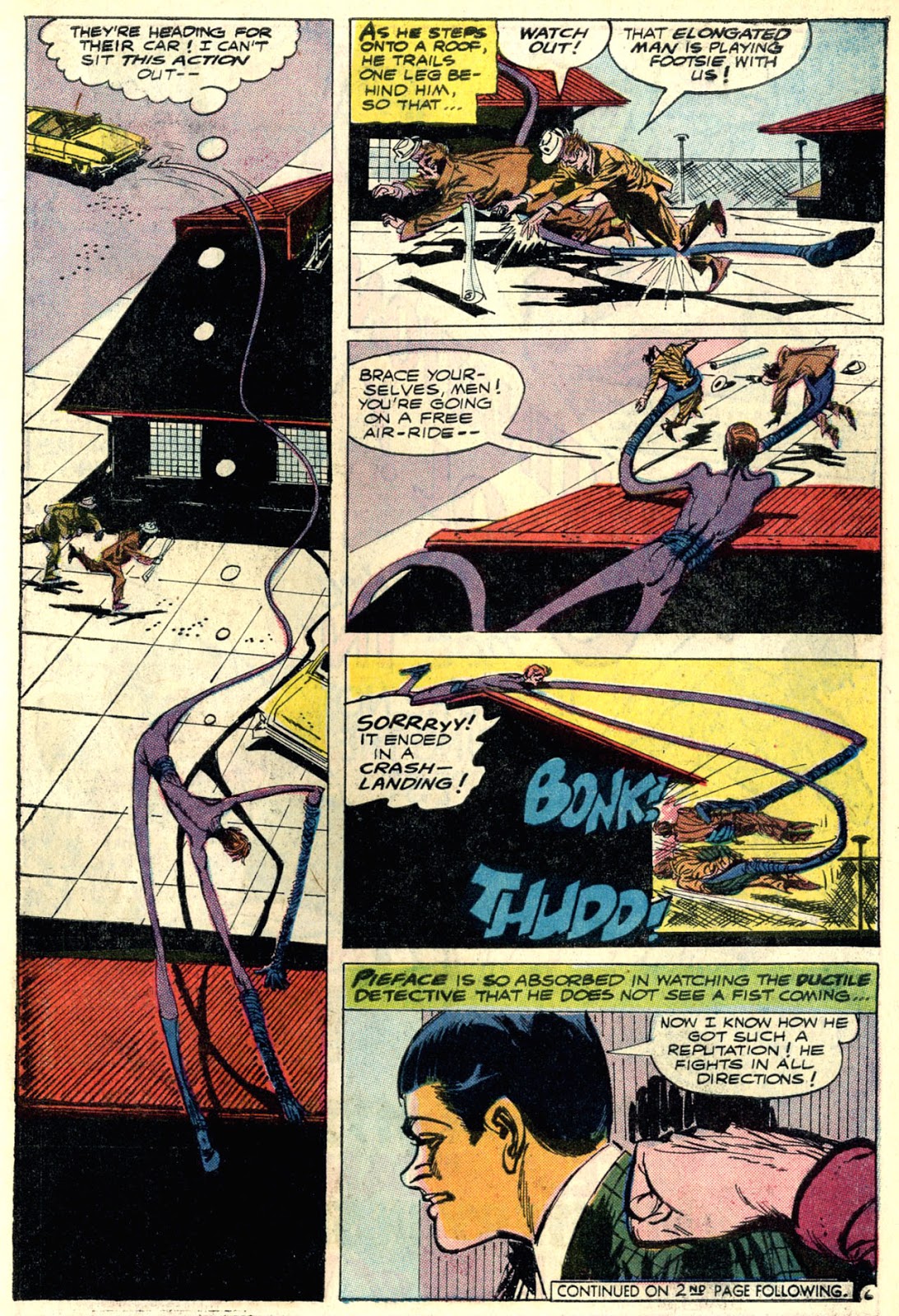
Ralph pulls himself onto the roof of a building to trip a couple crooks and then whack them against the building. Hal and Tom get into the fight and eventually all three wind up taking out the crooks. Tom gets the police who cart off the crooks.

This fight scene has some good visuals, but cutting between Tom and Hal and over to Ralph, it lacks the fluid motion we often get in Infantino's fight scenes.

Ralph has Tom confront Hal, who makes him concentrate on his invisible ring and have him restore his memory. The ring speaks and reveals that Hal passed through some gas that had a strange effect on him, making his sense of time screw up and forget that he's the Green Lantern.

It's now that Tom tells Hal that he let Ralph know that he's Green Lantern. Hal is willing to let Ralph have this information, but Ralph says he'd prefer to figure it out himself and Hal wipes that bit of information from Ralph's memory, and then Ralph notices that it's 1:59, and he's far from the hotel. Hal, however, transports him back with his ring.

Ralph is surprised to be surrounded by the media as Sue hands him a large wrapped box, which he opens to find a new costume.

Sue comments that Ralph's costume—which, we may recall, he's had since his debut in The Flash #112 just now without the mask—is "so drab," so she designed a new one and arranged for publicity.

Ralph tries on his new costume, which is primarily red with a black v-neck shape on the chest, as well as black gloves and boots with yellow trim, with a matching yellow belt. The new design is greeted by applause.

Okay, first, the story. It's serviceable, except Ralph doesn't get to really do much sleuthing and winds up just providing Tom some fire power. This feels more like it should've been a Green Lantern story guest starring Ralph versus the actual story, which is vice versa.

Now, onto the new costume. I don't love it. Mainly because it's extremely similar to Plastic Man's, which would prove to be bad timing as Plastic Man would return months later in July 1966 in House of Mystery #160. This was actually a "Dial H for Hero" story that saw Robby Reed use his dial to turn into Plastic Man to save the day. (Written by Dave Wood, art by Jim Mooney.)

However, the appearance of Plastic Man would be so well received that DC began their first Plastic Man series with a November/December cover date for 1966. While Ralph's costume was supposed to be red, it would often be colored differently, and I'll definitely be pointing it out.

In addition, I like purple being Ralph's color. This completely changed it.

Next time, what happens to the old costume?

The 13 O'Clock Robbery!

Detective Comics #349 has a cover date of March 1966, and is on Comixology and DC Universe.

Over in the letters page, only Gregory Kopko of Stratford, Connecticut writes in about "Robberies in Reverse!" He says the story was wonderful as usual "except for the part where Sue was tickling Ralph under his arm. He could of just put down his arm and push Sue out of the way—but of course that was a ticklish situation and problem."

Notably, the letters page sees Henry Goldman of Philadelphia, Pennsylvania guess that Batman's recurring foe "The Outsider" is none other than an amnesiac Alfred, who was killed some issues back. Julius Schwartz calls it the best guess yet and mentions that Alfred will be appearing in the new Batman TV series, soon to debut.

"The 13 O'Clock Robbery!" was written by Gardner Fox while Carmine Infantino inked his own pencils for the first time in awhile, Gaspar Saladino lettered while Julius Schwartz served as editor.

The splash page is probably one of the most eye-popping ones in some time. Ralph is getting hit and stretched out by three boxing gloves popping out of the walls and ceiling and floor. Meanwhile, his target, a strange-looking man peeks out and laughing that the burglar alarm's traps are helping the crook, not the "Crook-catcher." It's not a bad splash page, except for how the crook comes off as looking a bit Asian.

Okay, as I stated in the credits, Carmine Infantino returned to inking duties on this story after a long time of Sid Greene handling it, and the difference is rather striking. Some of Infantino's panels look rather bad and suffer from weird details. Sue's appearance here is pretty bad. Where did you go, Sid Greene?

Our story is set near Lake Cherokee in the foothills of Vermont, which again, doesn't really exist. Ralph is getting ready to go fishing, surprised that Sue was letting him go, but then discovers that she wants to accompany him, because she has a designer lady angler's outfit she wants to wear.

There is a nice bit where Sue says "A wife's place is with her husband! Her interests should be his interests! I think fishing's going to be a lot of fun!"

It's a nice sentiment, but I've met couples who have differing interests and they find ways to compromise and make it work between them, even if it involves going to events they typically wouldn't be interested in. That said, if Sue is genuinely interested in fishing, that's great.

Ralph mentions he fished at Lake Cherokee as a child, but when he and Sue arrive, they find the lake dried up. So it's surprising when Ralph notices he's not the only fisherman at the lake as there is another seemingly fishing like normal.

Ralph's nose begins twitching and Sue decides it's time to cut out. She says there's something important in town that she wants to do. Wait, what happened to "A wife's place is with her husband?"

The fun thing is that Ralph stretches his ears to listen to Sue.

The mysterious fisherman keeps casting his line into different spots of the muddy lake with a magnet, trying to bring up something. Finally, he cheers that he found something.

Ralph switches to his Elongated Man uniform and follows the mysterious fisherman through tree tops in some very good art by Infantino.

Ralph sees that the fisherman is heading to the home of the late Elmer Ewell, and then witnesses him knocking out the caretaker of the house. (Geez, Ralph, you didn't act now? He just harmed an innocent person.)

The fisherman goes in and Ralph is intrigued when he hears the clock chime thirteen times. Peeking into the house, Ralph sees a hidden door open to a money vault and the fisherman heads in.

Ralph realizes that Elmer Ewell was a rich man and that the fisherman is obviously not a beneficiary of the estate.

Ralph thinks of the fisherman as "Izaak Walton," which I briefly wondered if I'd missed Ralph picking up his name, but it's a reference to the author of The Compleat Angler, first published in 1653. How did these references work in a pre-Google age? Guess you'd have to hope to have a good encyclopedia on the shelf.

Ralph accidentally sets off an electronic eye loop which activates burglar traps, setting off boxing gloves on mechanical arms that punch him and stretch him out.

The fisherman notices Ralph and delivers him a punch, knocking him out.

To add insult to injury, the fisherman makes some puns. "When it came to rigging up a burglar-proof alarm system—he sure was punchy!" And then, "Those gloves are eye-poppin' all right—but not as eye-poppin' as my fist makin' contact!"

The fisherman shoves Ralph into the vault, which happens to be air-tight, and thinks about how the clock-key he fished up let him get past the traps harmlessly. Now he's got the money and is sure he's got one ductile detective down.

There is a lot of Ralph stretching. I'm very convinced Infantino loved drawing Ralph's powers in action. This is feeling like a fair trade off to seeing Infantino ink himself again.

Ralph awakens in the vault and has to figure out how to get out. However, when he spots a light fixture, he unscrews the bulb and manages to thread himself out through the fixture.

Getting outside of the house, Ralph spots Jabez the caretaker, who's recovering from being attacked earlier.

Ralph informs Jabez that he'll be trailing the man who attacked him and that his tracks will be easy to follow.

Ralph, buddy, maybe you could also ask Jabez to call the police as you'll almost be certainly be needing them?

Ralph tracks down the fisherman with Infantino drawing him with his head close to the ground, his body fluid. He finally reaches a cabin where Ralph overhears the fisherman being addressed as "Chuck" and being threatened by a gang he used to belong to.
They critcize Chuck for going "Lone Wolf" since he got out of jail and he explains himself. He was going to directly rob Elmer Ewell near the end of his life, but witnessed him going into his money vault. He was caught and knocked out by one of the booby traps.

In jail, Chuck read about Ewell's death and for some reason, the newspaper mentions the clock key being thrown into Lake Cherokee. So he determined to find it and get Ewell's money for himself.

Chuck really got lucky that the key would respond to the magnet he was using. Or maybe he's been doing this a long time and this is the day he finally had the right magnet and the right aim.

Anyway, now that Chuck has his prize and is being held at gunpoint, he offers to split the goods with his old gang. Except Ralph just overheard the whole thing and makes his move.

Time for an Infantino Fight scene going for TWO pages!

So, Ralph reaches in to grab the loot and stretches a finger to knock out one crook. Some of the others try to fire at him, so he moves around to other side of the cabin, still holding onto the bag. Distracting them with the rest of him, he now lifts the bag...

...And uses it to whack two of the crooks! Chuck now tries to punch him again, but Ralph puts his nose to work, then hits the first crook again, then uses his knees to deliver another blow to the other two, then gives Chuck a big old wallop.

It's not really until the next panel that it's clear that there's been three other gang members along with Chuck, making a grand total of four guys Ralph handles. Would've been nice to have all four in one panel earlier.

Still, Infantino is in top form drawing these action scenes, which are the real highlight. They're very lively.

Ralph takes the four gangmembers in their car and Chuck's jeep and manages to drive both simultaneously. That can't be safe. Or legal. I knew he should've had Jabez call the police.

After so much fun, Ralph gets back to his motel room and wants to relax, but he notices Sue packing up, saying they're going to Lake Indian Head, which again, doesn't exist. There's an Indian Head Lake in Arkansas, but I'm sure that's more than the "couple of hundred miles away" that Ralph says it is. However, Sue has heard there's good fishing up there and is anxious to go.

The final panel has Sue driving the car, Ralph bemoaning the "good old days when wives let their husbands go fishing alone."

I won't call that sexism as Ralph doesn't want to fish right now, he wants to relax!

Overall, this is a better action story than a mystery. There's only two pages where Ralph isn't using his powers, the first page and the page where Chuck tells his story. Still, it was a pretty fun one.

Next time, Ralph teams up with another superhero and we are introduced to the iconic second costume.

Actually, I'll likely be posting my review of Parts 4 and 5 of the CW's Crisis on Infinite Earths crossover first, but don't be surprised if it's a little late as my actual paying job scheduled me a shift that conflicts with the broadcast time.

My Wife, The Witch!

Detective Comics #348 has a cover date of February, 1966. It's available on Comixology and DC Universe.

In the letters page, there was a lot of buzz about "Peril in Paris!" Leonard Tirado of Saratoga Springs, New York thought seeing Ralph in a foreign country instead of a US setting was a welcome change, and even claimed the US-based stories were showing some wear and looks forward to Infantino drawing more foreign places. Earl Krizek of Philadelphia, Pennsylvania guesses correctly that John Broome wrote the story, and says that it was enjoyable, except for the reason of "Sue's change of identity." Mitch Theophila II of Wadsworth, Ohio was far more critical of this point, saying it ruined the story. He opens by saying "What a waste! I can truthfully say that the writer probably laid the biggest egg of his career when he conceived the explanation..." He does compliment the art, though.

"My Wife, the Witch!" was written by Gardner Fox with pencils by Carmine Infantino and Sid Greene on inks, Gaspar Saladino lettered while Julius Schwartz served as editor.

The splash page teases that Sue suddenly acquires magical abilities, with an image of her wearing a stylish witch hat next to a broom under the title. The text further goes on to tease that Ralph is going to figure out what happened to Sue. So the art shows Ralph getting knocked out, stretching across the room, despite seemingly having knocked out two men already.

Not a fan of this art. It would be better if it showed Sue doing her "magic." That would be more enticing. The man's dialogue also just says what you can clearly see just happened.

It's a rainy night as Ralph and Sue arrive at the Pine Beach Hotel, just outside the (later revealed) town of Malem. (If you haven't guessed, it's a one letter change for Salem, Massachusetts.) The rain is so heavy, that Ralph and Sue are dripping wet in the time it takes to get from the car to inside the hotel.

Entering, the couple are informed that their reservation is not on file, but Ralph spots that a room key is still hanging up in the box for Room 13. The owner and manager, Gregory Hunt, protests that the room is haunted, but in a total power move, Ralph stretches his arm and grabs the key.

The next morning Ralph is heading downstairs to take their car to be serviced and informs Gregory that they slept soundly. Meanwhile, Sue finds a book about witchcraft in her room. It's heavily damaged, but three spells are legible. Sue decides to try them, and the first requires her to throw a feather over her shoulder and speak a spell to make a lamp levitate and move through the air. It surprisingly works.

Sue tries the second spell, which requires her to drink salt water and stand on her head while reading the spell, which alters the lights in the room into a strobe effect.

Sue then calls Ralph at the garage to ask him to pick up things for the third spell. He's puzzled as to why Sue wants these weird items, but when the mechanic hears the items, he informs Ralph that he can get the items at the Malem Museum's Witch's Museum gift shop.

While Ralph is at the Museum, three crooks try to rob the till. Ralph quickly changes behind a screen and springs into action as the Elongated Man. Infantino fight scene, coming up!

Admittedly, this isn't one Infantino's best as Ralph is mostly obscured through the fight, but he still conveys action nicely.

Ralph knocks one crook out with a spinning wheel, and the second one is able to recognize that the stretched out arm could only belong to the Elongated Man. This one is then knocked out by Ralph throwing a punch from a display.

The third crook tosses his gun as he knows it's useless to shoot Ralph and Ralph instructs him to put his hands in the air in surrender.

Turns out the gun was actually a smoke bomb with knock out gas! The final crook gives Ralph a punch that stretches him across the room.

The three gangsters begin their getaway, when they notice a long nose sticking out of the window. As it turns out, Ralph made sure he'd be knocked out so he'd be by the window so he could stretch his nose out, being unaffected by the knockout gas.

Ralph gives the three gangsters another knockout before taking them to the police department. Afterward, he returns to the hotel where Sue explains the third spell is for the heart's desire, allowing her to wish for whatever she wants.

Ralph scoffs at the idea of this witchcraft being real and mentions that he forgot the items Sue wanted given the crooks he just helped round up.

Sue tells Ralph about her magical feats, but the book (conveniently) says each feat can only be performed once. Ralph replies with a cute "Sue, honey—the only witchcraft you ever worked was when you got me to propose to you..."

 He then begins to think that perhaps Sue's magic was a trick to get him to the museum to catch the crooks. But who'd know they were there? The gang's leader who doesn't actually do the jobs, just orders the others to do it. With nose twitching, Ralph calls the police. (Presumably, Ralph heard about the gang's leader while dropping the gang off.)

The scene shifts over to Mr. Hunt who goes over his own dilemma as he listens in on Ralph's phone call. (Remember when you could do that?) We follow his thoughts as he reveals that he is the gang's leader and wants to keep the loot they've collected for himself, which is why he arranged for Ralph to arrest them by setting up gimmicks to make Sue's first two "spells" work.

He watches Ralph go to the car and head to the police station, and then goes to pack up his stolen goods. As he heads out, he finds Ralph waiting for him. Hunt swings at Ralph, who explains as they fight that he tricked Hunt to catch him red handed. The coincidences lined up too neatly for the gang leader to be anyone else but Hunt.

Hunt decides to blind Ralph by spraying him in the face with insecticide, but Ralph simply sprawls himself around the room, creating an impossible trap for Hunt. Ralph soon wraps up Hunt and takes him to jail.

Wrapping up the story, Ralph confirms with Sue that it was all a trick.

Sue confesses that the last spell, for "Heart's Desire," would've been used to make her the most beautiful girl in the world so that he'd be proud of her.

He embraces her and says "Silly girl! How could you ever be more beautiful than you are right now?"

It's a sweet ending, but the whole idea of Sue being gullible to fall for believing she can do magic smacks a bit of sexism. Even Ralph's well-intentioned "Silly girl!" is a little off. Not to mention her wish is a bit shallow. She wants to be beautiful. There's nothing else Sue could wish for?

It's a fairly well done story, but sells Sue off as a bit too naive for my liking.

Next time, Sue wants to go fishing.

The Man Who Hated Money!

Detective Comics #347 has a cover date of January 1966 and is on Comixology and DC Universe.

This was the earliest issue of Detective Comics I can remember my father owning (in an original printing, that is) with an Elongated Man story. Unfortunately, I don't believe he still owns that copy (or much of his comic collection), so this is just a bit of fond reflection for me.

Over in the letters page, readers were buzzing about guessing the writer of "The Secret War of the Phantom General," with one reader wondering at whose picture in the panels with John Broome could've been used as a dartboard, and deducing that it must be the editor, which Julius Schwartz confirms with a humorous "Dart's right!" No specific mentions of Ralph.

"The Man Who Hated Money!" was written by Gardner Fox with pencils by Carmine Infantino and inks by Sid Greene, Gaspar Saladino lettering and Julius Schwartz as editor.

The splash page does not depict a scene in the story, but instead depicts the concept of the story, with Ralph literally stretching to catch a generic looking masked crook who wants to destroy money, but the crook seems to just be out of his reach.

Come to think of it, this might be one of the best splash pages yet. It gets us interested in the story but doesn't spoil anything. I don't think there's been one like this since Ralph's Detective Comics debut, which actually had nothing to do with the story.

The main action of this story takes place in Silver City, which is said to be near a small town called Four Corners. There's no real life match up of places of the same names that seem to fit, however there is a Four Corners neighborhood in Silver Springs, Maryland. A Silver City is the home of some supernatural characters from the DC universe, but it's not clear if this is the same one.

The story starts with radio DJ Flip Philips reporting on getting mugged and the thief taking the bills he had in his wallet and ripping them to shreds, explaining that he hates money more than anything.

Infantino draws the mugging well in four panels, focusing on the thief's hands.

The story makes the paper and Sue Dibny happens to read it before her husband. Noting the story, she checks out of their Four Corners hotel and shows the story to Ralph and prepares to head to Silver City. She is not avoiding the case, she actively brings it to Ralph's attention and prepares to head off so he can investigate it.

Arriving at the Silver City Police Department, Ralph is told that Antoine Lemaire of the Continental Cafe reported that he was robbed by the Money-Hating Robber who proceeded to tear up the dollar bills in the cash register. Then, Hannibal Holiday, an artist, arrives and claims he was robbed by the Robber at an art exhibit, who turned his cash into confetti.


Ralph decides to lure the Robber out by going on a spending spree with Sue, much to her delight.

As Ralph goes for a stroll that night, he's mugged and hands over his money to try to figure out what the issue with the Robber is.

Only the mugger is just a regular thief.

Ralph tries to stretch his fingers after the thief, but gets them smacked by an accomplice.

Ralph quickly pulls off his civilian clothes to reveal his costume and heads off after the crooks, stretching his legs out. In a great Infantino scene, Ralph quickly catches up with the mugger and grabs him and whacks him against a building, presumably knocking him out with a trail of dollar bills.

Then he goes after the accomplice, who's preparing to shoot him.

Ralph goes after the man's gun with his elongating arms, making him miss before punching him out.

The two crooks are taken to the police department where the lead actor and actress of a play titled "Heart to Heart" enter, reporting that they were victims of the Robber.

Actress Rhoda Marr reports their show was nearly an empty house that night. August Clemens, the lead actor, says they got into his car and were met by the Robber, who then held them at gunpoint so they'd surrender their money, which he tore up before running off into the night.

The next day, Sue goes to see the art exhibit at Town Hall, but there's a long line of people waiting to get in. (The next page has her say it's a three hour wait.) As she waits, she hears a portable radio play a song from Flip Philips titled "The Man Who Hated Money."

Afterward, Sue goes to the theater to get a ticket for a performance of "Heart to Heart," but they're sold out.

The story goes forward to Ralph coming back to their hotel room, saying his questioning of the victims led nowhere. Sue tells him about her own day, adding that she went to the Continental Cafe, and was informed that the time to be seated was predicted to be two hours. She concludes with "I just wish that money-hating bandit would hold me up! I'd like to be doing as well as his victims!"

This gives Ralph the major clue he needed. He kisses Sue from across the room by elongating his lips. He decides to reveal the identity of the robber at the Silver City Theater the next morning, in front of the victims.

The next morning, Ralph's reveal is spoiled by a gunshot from the manager's office, and he goes to see what the trouble is.

Arriving in the office, Ralph finds the manager is the one who fired the shot to get Ralph's attention. The manager's being held up by a couple crooks who are set on taking the box office take.

When Ralph tries to punch at them, they catch his hand in a bucket of quick-drying cement, and the other hand is quickly taken out of commission by an electrical shock delivered by an electric goad.

Those guys aren't even wearing gloves to handle that goad, they could seriously hurt themselves like that. This is more commonly known as cattle prod.

However, Ralph is a sharp one, and uses his temporarily out of commission hands to anchor himself, so he can knock out these crooks by using his legs.

And he can't resist a good pun, so here's his dialogue. "If you crooks really want to see some electrifying—here's my current offering! You fellows plugged in on something you can't handle!"

I'll note the manager must have made a hasty exit as he isn't seen after the first panel on the page.

This page really has nothing to do with the main plot, it's like they needed to fill one extra page, so they gave Ralph another fight scene. But I'm not one to say no to a good Infantino fight scene for Ralph, so it's a nice addition, though honestly, I would have preferred if the Continental Cafe had gotten more than one panel earlier, as it makes us nearly forget about it because it's so brief.

Also, Silver City has one major crime problem if Ralph randomly runs into four crooks.

Ralph resumes his reveal: there is no Money-Hating Robber! The story was created by Flip Philips as nothing more than a promotional piece for his song, "The Man Who Hated Money."

Ralph goes on to point out how all of the "victims" wanted publicity and took advantage of the story to get their names out there, which paid off majorly. He then goes on to point out they'll be charged with filing false robbery reports, which is a crime in and of itself.

The victims admit their guilt, with Rhoda Marr suggesting they donate their newly accrued funds to the community chest.

As Ralph and Sue go back on the road the next day, Sue discovers her spending money is gone. Ralph tells her that he donated it to the community chest "in the name of the Money-Hating Bandit!"

This is actually well-done story. As mentioned above, I think some other parts could've used a bit of expansion rather than giving Ralph another fight scene, although it was a good one. Ralph is given a mystery, and with help from Sue is able to solve it.

There is one tiny flaw: if the Robber just destroyed money on the spot, why weren't the police suspicious that evidence wasn't being brought in or found at the crime scene? I'm not sure if this was the case in 1966, but mutilated bills can be turned over to banks or mailed to the Bureau of Engraving and Printing for replacement if more than half of the bill is there.

Anyway, well done to Fox and Infantino on this one.

Next time, must be the season of the witch.

Two Batmen Too Many!

Well, here's a first. This is a story where Ralph more or less appears in a cameo.

Batman #177 carries a cover date of December 1965. Carmine Infantino did the cover with inks by Murphy Anderson and Ira Schnapp provided the logo. "Two Batmen Too Many!" was written by Bill Finger with pencils by Sheldon Moldoff, inks by Joe Giella, lettering by Gaspar Saladino and Julius Schwartz served as editor. The issue is not currently available on Comixology.

Ralph does but doesn't appear on the cover, which doesn't reflect a scene in the story. It teases three different Batmen: regular Batman, a giant one and a tiny Batman.

The splash page sees all three of the Batmen taking on crooks in three panels. Only the regular sized one is accompanied by Robin, though.

The story begins with Ed "Numbers" Garvey feeling targeted by Batman. He used to run a numbers game, but became obsessed with a jewel heist. He flees to a cave and finds two figures seated on thrones, one very tall, the other very short. His torch reflects light into a crystal and turns the figures into clones of Batman, who say they'll be his slaves.

Ed takes the Batmen to his gang back in Gotham City. When the fellow crooks try to fight them, the Batmen make short work of them. They're about to have the Batmen do a job, when the little one says it needs to be revitalized with star light reflected through a blue-white crystal. The little Batman goes to help them knock off a carnival, but the robbery is stopped by the real Batman and Robin, though the crooks get away.

Back at the hideout, the Big Batman needs revitalized with a ruby. When Big Batman claims to be revitalized, Garvey has them knocked out, revealing he suspected the Batmen were frauds and that the ruby he just used was a fake.

Removing the Batman costumes, they discover that the Batmen were actually Elongated Man and the Atom.

Garvey decides to unmask the Atom to discover his secret identity (chances of him recognizing Ray Palmer at the time is very low, though), but Batman and Robin enter and begin fighting the crooks. Garvey tries to get away via a trap door, but Batman manages to catch him.

Now comes an explanation of the whole plot. Batman did indeed arrange things to make Garvey go to that cave and find Ralph and Ray in costume.

The "revitalizing" with a gem act was to get radioactive powder onto the gems so Batman could find them with a Geiger counter.

When the crooks left to knock over that carnival, Batman and Robin found the diamond in a clock, realizing that each gem was hidden in different locales.

Garvey thinks he's still got the rest of the jewel collection hidden away, but the ruby act worked because he held the fake gem in the same hand as the real one (just in case) and the radioactive powder got onto the real one, which Batman finds in a telephone.

The rest of the gems are found in spots in the hideout related to numbers: in a typewriter, behind the door's number, in a hollow in a desk calendar and in a dummy algebra book.

To be fair, anyone besides a mathematics whiz owning an algebra book outside of a school is already pretty sketchy.

With all of the gems recovered, it's now time to take Garvey to prison.

The story tries to keep it down to earth with a wacky concept, and luckily, Batman was given connections to Ralph and Ray prior to the story. It's just wacky that the crooks went with the concept at first of clay figures being brought to life that look like Batman. Silver Age stories, am I right?

Sheldon Moldoff becomes the first person aside from Carmine Infantino to draw Ralph in the pencils for a story, and he doesn't do a bad job at all. Except that he doesn't really show Ralph stretching. Most of the time, he's not drawing Ralph, but an oversized Batman.

Interesting is that you can see Ralph's face clearly a little deformed as he had to stretch his chin to mimic Batman's face. This marks the first time we saw him take on face molding, something that other writers would make use of much further down the line, and even make its way to The Flash TV series.

So, not a bad story, but not quite a memorable one. And my tease last time wasn't wrong, Ralph did get a new costume: a Batman costume!

So, next time, we're heading back to Detective Comics as Ralph completely fails to catch a criminal.

Where Ralph could fit in James Gunn's DCU (and Plastic Man too!)

 So, hi! I haven't forgotten about this blog, it's just time gets away from me, there's other stuff I want to handle. If I could...