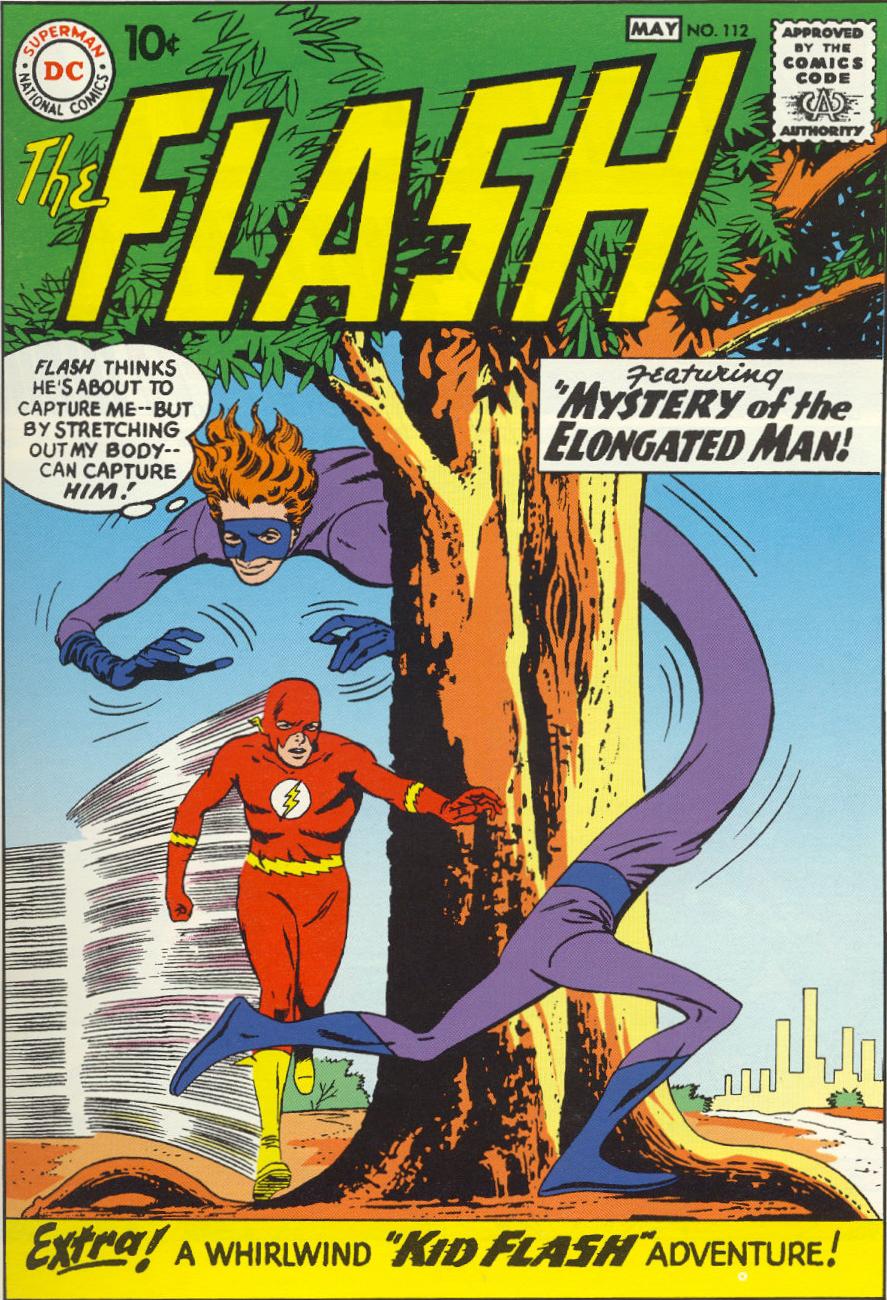
The question of Ralph Dibny's powers pops up occasionally. What can he do, what are his limits, and what differentiates him from other superheroes with similar powers like Marvel's Mister Fantastic, DC's Jimmy Olsen as Elastic Lad, and Plastic Man, the first elastic superhero that DC acquired from Quality Comics?"Before you read this, remind me to tell you the difference between Plastic Man and Elongated Man." — Seth Cohen, The O.C.


If I'd been writing this about ten years ago, the answer would be quite simple, but now there's been at least two new incarnations of Ralph: the one that showed up in DC's New 52 continuity in 2014 to 2016 during Gail Simone's Secret Six run, and the new one on The Flash TV show. These new versions are different from the original one that first debuted in The Flash #112 in what they can do.
Please note that this may include spoilers, particularly for that run of Secret Six and Season 4 of The Flash TV series.

The original Ralph initially got his powers from drinking a fruit extract that allowed him to stretch. Eventually, it was revealed that this reacted with a metagene he had the entire time, but the gingo extract triggered his powers. This would let him stretch his body for about 100 yards (as mentioned in Detective Comics #340). Ralph can alter his body to an extent: he cannot change colors and he generally has to keep a humanoid form. He can flatten his form, but he can't go so thin that his blood can't flow properly or else he'll pass out. Eventually, Ralph attempts to disguise himself by molding his face. (Some attempts do show him with a different hair color.) It's important to note that as various writers and artists handled the character, they played a little loosely with what he could and couldn't do.

Original Ralph is quite comparable to Mr. Fantastic in his power set, with one interesting exception: Ralph cannot be made to stretch or change shape by external force. There are instances of him being knocked out and he always dodges bullets. (If he's bulletproof, he's not testing it.) Mr. Fantastic can be overpowered and made to change his shape (seen in Fantastic Four Annual #1).

The Ralph we meet in Secret Six is a little more of a conundrum in that it appears his powers are permanent, but we don't know how he acquired them. He's seen drinking from a flask in the first issue, which might be a callback to Ralph drinking gingold from one in 52, but whatever is in the flask is not specified, and as Ralph mentions "hair of the dog," it's presumably alcoholic.

Ralph spends most of the run of Secret Six disguised as a man named Damon Wells with the codename Big Shot. Big Shot is heavyset, which varies. Sometimes he's just a man with an imposing frame and black hair, other times he has a huge gut, and in issue #5, he transforms into a near mountain of muscle. Yet it's also #5 that shows us Ralph before the series, and he appears similar to the original Ralph with a slim frame and red hair. When Ralph resumes being the Elongated Man at the end of #12, he returns to his slim frame and red hair. So seemingly, this incarnation can change color to some extent.

Personally, I believe this incarnation is more in line with the Ralph we see in the CW's The Flash television series. First seen in the season four episode "Elongated Journey Into Night," it's revealed that Ralph was riding a bus that was inundated with dark matter when Barry was broken out of the Speed Force. He and the other passengers were transformed into metahumans with superpowers that they eventually discovered. This version of Ralph is able to be stretched by external force and has been demonstrated to be invulnerable to bullets and is able to contain explosions by ingesting the explosives.

The CW's Ralph doesn't use gingold to activate his powers, but Iris does find a bottle of gingo extract in his office, and later Ralph orders "gingold on the rocks" at a bar. The use of gingold is given a brief tribute as Ralph is able to stretch when he's first seen, but not able to resume his normal form until Caitlin Snow creates a serum that stabilizes his powers.
The CW's Ralph is seen molding his hand into the shape of a balloon animal and in a bonus scene, transforms his body into the shape of a snowman. In the most recent episode, he exhibits more or less the same power seen in Secret Six as he discovers he can shapeshift and disguise himself as different people, changing hair, eye and skin color.
For this (and the CW's Barry Allen suggesting the name as an Easter egg), a number of people have presumed that the CW's Ralph is operating with Plastic Man's power set, some still presuming that Ralph is Plastic Man.

Plastic Man's power set has been depicted as being far more extensive than Ralph's, often turning into shapes that would otherwise be inanimate, he can also compress into tiny shapes and has been shown doing this while Ralph hasn't. The short version of the difference between Plastic Man and Ralph used to be "silly putty vs. a rubber band." However, the CW's Ralph has been described on the show as being like silly putty, having his cells "polymerized" by the dark matter. But this Ralph by being able to change color is actually a bit more like Plastic Man's son Offspring than Plastic Man in that regard.
The CW superheroes have always played loosely with comic book lore, and likely for their Ralph, rather than work with the comic's limitations, they just opened it wide as it's not likely they'll adapt Plastic Man or Offspring.

I did mention Jimmy Olsen taking the identity of Elastic Lad, which happened in a number of issues of Superman's Pal, Jimmy Olsen. This identity first occurred after exposure to liquid kryptonite, then reoccurred thanks to a serum developed by professor Potter. (An issue of DC Comics Presents claims gingold is part of this serum.) Jimmy's powers often just had him stretch nearly infinitely. (One issue had him stretch his fingers into a confusing maze that stumped a villain trying to escape.) When surprised by a runaway steamroller, Jimmy was flattened but was able to resume his normal form with no ill effects. Probably most impressive was a story opening with Jimmy as Elastic Lad not only being a human cannonball, but also being the cannon and safety net. Thus it's fair to say Jimmy's powers while using the serum were very comparable to Plastic Man's.

So, that's how Ralph stacks up to the other main elastic heroes of comics. The original version of Ralph had a variety of limitations that seem to have become less in his new incarnations in Secret Six and The Flash TV series.
But of course what really set Ralph apart was his penchant for solving mysteries and his detective skills. His ability to spot things that were off and deductive reasoning gave him something besides just his physical superpowers to make him a standout superhero.
And yes, we're sticking with the explanation in Identity Crisis that sniffing out a mystery was just a developed twitch for show.