Showing posts with label comics history. Show all posts

Who Is Sheldon Moldoff?

As it turned out, the second artist to draw Ralph for comics was none other than the legendary Sheldon Moldoff.

Moldoff was born on April 12, 1920 in Manhattan, New York and he was raised in the Bronx. Moldoff said he would draw cartoon characters in chalk on the sidewalk, and his neighbor Bernard Baily saw and offered to teach him to draw.

Moldoff's first page
for DC Comics.

Moldoff began drawing comics at age 17, with his first comic book publication being a sports page published in the inside back cover of Action Comics #1. Which, of course, also introduced a little DC character called Superman.

Moldoff said he would save newspaper comic strips and learn to copy their style. When he had to draw Hawkman, he turned to the style of Alex Raymond's Flash Gordon strip to make it work. He would be the first to draw Shiera Sanders as Hawkgirl, giving her a similar design to Hawkman. He would also draw the cover for the first issue of All-American Comics that featured Alan Scott, the original Green Lantern.

Moldoff would serve in World War II from 1944 to 1946, but soon returned to comics. While he'd primarily work with National Comics and the other publishers that would eventually end up merged into DC Comics, he also did work for Quality Comics and Timely Comics (later Marvel), Fawcett and EC, the latter two of which saw him work in the field of horror comics, the shocking titles that would eventually spur the book Seduction of the Innocent and lead to the Comics Code creation. At DC, Moldoff would draw many Batman stories that were actually credited to Bob Kane, imitating his style.

Some of the many DC characters that Moldoff co-created include the original Batwoman and Bat-Girl, Ace the Bathound, Bat-Mite, Mr. Freeze, Calendar Man, the second version of Clayface, Poison Ivy and the Spellbinder. However, despite this, he left DC in 1967 when they refused to offer healthcare and retirement benefits.

Moldoff would continue drawing comics, mainly for promotional giveaways. He would also venture into animation. He would write the animated film Marco Polo Junior versus the Red Dragon. When comics conventions became popular, Moldoff was willing to attend and offer samples of his work to fans. He would win an Inkpot Award in 1991.

Moldoff retired to Fort Lauderdale, Florida with his wife Shirley. He died on February 29, 2012, survived by his three children, four grandchildren and three great-grandchildren.

Who is Bill Finger?

Who is Bill Finger indeed? Well, as history wound up making it, the third person to write a comics story featuring the Elongated Man. But, if you're familiar with comics at all, you know he's responsible for a lot more.

Milton Finger was born on February 8, 1914 in Denver, Colorado. His family shortly moved to The Bronx, and he graduated from DeWitt Clinton High School in 1933. At a party, Finger met fellow DeWitt alumnus Bob Kane and began working with his comics company in 1938, ghostwriting comics strips. He shortly took on the pen name "Bill."

The next year would see the comics world shakeup with the introduction of Superman. Now, every comics creator wanted a piece of the superhero pie.

Bill Finger revealed that Bob invited him to look at his new creation: the Batman. The character was dressed in red with black wings sticking out of his costume with a domino mask. Finger suggested some changes to the design: add a cowl, make the wings into a cape, add gloves, change the primarily red color scheme.

Batman would debut in Detective Comics #27. Finger wrote the first story and several early stories. This means that Finger established a lot of Batman lore: the Batcave, the Batmobile, Robin, Gotham City, the name "Bruce Wayne" and even Batman being a detective instead of just a costumed crimefighter. He would also co-create many of Batman's iconic rogues, including the Joker, Catwoman, the Penguin, Two-Face, the Scarecrow, the Riddler and Calendar Man.

That said, Finger was not officially credited for Batman's creation for a long time. Bob Kane got all of the credit. Kane eventually revealed that Bill was a major factor in shaping the beloved superhero, but he wouldn't receive credit in the comics until 2015. The first non-comics media credit would appear in 2015 in the second season of the Gotham TV series, and later in the 2016 film Batman v Superman: Dawn of Justice. This was thanks to his granddaughter Athena campaigning DC to finally give her grandfather the credit he deserved.

The company behind Detective Comics was eventually acquired by National Comics, who would become DC. Finger followed and would write for many DC stories. He would also co-create the original versions of DC heroes Green Lantern and Wildcat. He was known for carrying a notebook to write down ideas. He inspired the villain Black Hand.

Finger had married a woman named Portia and had a son named Fredrick with her. They divorced, and he remarried to Edith Simmons, but their marriage eventually ended.

Finger was found dead on January 18, 1974 in his home. He'd already survived three heart attacks, but occlusive coronary atherosclerosis was ruled the cause of death. It was believed that he was buried in a potter's field, but Fredrick had actually had him cremated and the ashes scattered on an Oregon beach in a bat shape.

Despite not getting proper credit in his lifetime, Bill Finger is now a recognized DC Comics legend. If you want to know more about him, Hulu released a documentary about him titled Batman and Bill. And despite what modern trends and interests have turned to, his work should still be read and enjoyed.

Who is Ira Schnapp?

I've already discussed the important role that letterers have on comics. As I say, if your lettering is bad, no one will want to read the comic book. But the talents of letterers can extend beyond the comic page. So get ready to meet a DC legend who got to work on Ralph, namely in the last story we covered: Ira Schnapp.

Israel Schnapp was born in Sassow, Austria on October 10, 1894. The next year, his father moved to New York City to begin work as a grocer, eventually bringing his family over in 1900. He had four brothers and two sisters who were born after the move. He graduated from Stuyvesant High School in 1913.

Schnapp's talent for designing letters was quickly put to use as he revealed that he designed the lettering for the James A. Farley Post Office Building, constructed from 1908 to 1912. On his World War I draft cared, he said he was employed for the W.T. Slide Company, which created title screens for silent films. While no credits to his name are known through the 1920s, this was work that usually went uncredited. In the 1930s, he would be designing lobby cards and posters for films, including displays for King Kong's premiere at Radio City Music Hall.

After working for publishers and advertisers, Schnapp began working for a relative of his wife: Jack Liebowitz, who along with Harry Donenfield was publishing pulp magazines. They eventually acquired National Comics. While people believe Schnapp designed the logo for Action Comics, he claimed his first work for DC was the Superman logo, which he revised from the original by Joe Shuster. The logo was revised in the 1980s to round out many of the letters, but the logo's style used to this day is the same that Schnapp designed for DC.

Schnapp became instrumental for DC throughout the years, designing logos and advertisements and lettering when available for a wide range of their titles. His design work is credited as making DC titles an exciting seller for young readers.

One work of Schnapp's appeared on hundreds of comic books by many publishers over the years: he designed the Comics Code Authority seal.

In 1966, DC's logo design duties were transferred over to Gaspar Saladino, who fondly called Schnapp "Mr. DC." Schnapp remained employed by DC for two more years, mainly as a professional courtesy, before the company retired him. Neal Adams claimed that Schnapp had been sent home to die, and Saladino said that when Schnapp left DC, it was as if he'd never been there.

Schnapp died of a heart attack on July 24, 1969. DC did not officially note his passing. He was survived by his wife Beatrice and their children Theresa and Martin.

I only briefly talked about Schnapp's work here as in researching, I came across two lengthy pieces documenting his life and works. If you're interested in reading more, I highly recommend them. The first is a feature on Dial B For Blog, which focuses mainly on Schnapp's work. The other is a series of blogs by Todd Klein which go indepth about the details of Schnapp's life. Enjoy these two tributes to a true DC legend who was confirmed to have worked with the Elongated Man at some point during his career.

Who is Sid Greene?

Not much seems to be known about Sidney Greene's personal life. This artist/inker for many comics was born on June 18, 1906.

Greene began freelancing for Funnies Inc., a comics packager, probably in the late 1930s. His first confirmed work was a "Spark Stevens" story appearing in The Green Mask #5 (1941) for Fox Comics. It's believed he worked on stories for Fiction House's Planet Comics and Fight Comics as early as 1940, but as comics were rarely credited, it's hard to say if he was the artist on them.

His first credited work was for a Patriot story appearing in Timely Comics' The Human Torch #5. As regular readers of this blog will know, it was not unusual for comics artists and writers in the Golden Age to take work where they could get it, so he worked for a variety of comic companies, so he worked on other comics for Timely, including Captain America, and would later freelance for them through the time they went as Atlas Comics before being re-branded as Marvel Comics. He would also work on comics for Novelty Press, Ace Comics, Eastern Color, Hillman Periodicals, Holyoke Publishing, Avon Comics, Orbit Publications, Quality Comics, and Ziff-Davis.

Greene's first known work for National Publications (DC Comics) was in Secret Hearts #18 in 1953. In a little over a year, he began working on stories in Mystery in Space, where he would work with future Elongated Man scribe Gardner Fox in creating the Star Rovers. However, he wouldn't begin working in superhero comics until 1963, when he inked a story in The Atom #8. The next year, he would begin inking the Elongated Man feature in Detective Comics, and the next year would see him put his inking talents toward Batman, both in the character's main title and Detective Comics. He would also begin inking regularly for Justice League of America in addition to various other comics.

Although Greene's work for DC became his claim to fame, in his later years, he freelanced for Marvel, inking a Ka-Zar story in Marvel Super-Heroes #19 and a feature story in Nick Fury, Agent of S.H.I.E.L.D. #12. Greene's final stories were published in March, 1970, in DC's The Unexpected #117 and House of Secrets #84.

Sid Greene died in a hospital in Port Jervis, New York in October, 1972.

Who is Carmine Infantino?

Well, we come to the penciler of the original Elongated Man stories at last. The artist usually got the main credit for the art, and to be fair, most of the time, it was their designs and layout that made up the comic. The final look of the page was down to the inker, of course, who might alter the art. But Infantino worked on both during his career.

Carmine Infantino was born on May 24, 1925 at his family's apartment home in Brooklyn, New York. He would later attend Manhattan's School of Industrial Art. His first comics job came during his first year of high school from comics packager Harry "A" Chesler. Chesler was known for being difficult to work with, but Infantino recalled him fondly, saying he was given a dollar a day to study artists at work and to improve at art himself.

At age 16, Infantino's first comics job came in inking the "Jack Frost" feature in USA Comics for Timely Comics, which would later become Marvel. He and his friend Frank Giacola (who drew "Jack Frost") were offered staff jobs, but Infantino turned it down at the insistence of his father who wanted him to complete his education.

Eventually, Giacola and Infantino swapped jobs on "Jack Frost." Infantino would do more work at Timely, as well as Fawcett, Hillman and Holyoke before getting work at All-American Comics, which would later be folded into National Publications, which would quickly become known as DC Comics. His first work for All-American was the story "The Black Canary" for the "Johnny Thunder" feature in Flash Comics #86. This was the debut appearance of the villainous Black Canary who would be revised into a heroine. He would eventually work on many other superheroes who would become some of the best-known DC characters.

Between the decline of superhero comics and the Silver Age, Infantino worked on mysteries, romances and Westerns, which kept the comic medium alive. He also freelanced for the short-lived Prize Comics.

Infantino was responsible for designing the new costume for the Flash for Barry Allen's first appearance in Showcase #4. He gave the Flash a cowl instead of a helmet, transforming the costume into a one-piece bodysuit with boots. He also created the motion lines to suggest super-speed. This new design paired with a more science fiction approach to the character became a hit and ushered in the Silver Age of superhero comics.

Infantino would work with a variety of writers and worked on many DC characters and titles, co-creating characters such as Barbara Gordon's Batgirl, Deadman, Blockbuster, the Human Target as well as the Elongated Man. In the face of an offer to move to Marvel, Infantino was promoted to art director. When DC was bought by Kinney National Company (now Time Warner), he was made editorial director. He was responsible for signing on many new and established artists, including bringing none other than Jack Kirby to create new characters and comics that would introduce elements that would become essential parts of DC lore.

In 1971, he would be promoted to publisher. Under his leadership, DC comics went up to 25 cents per issue, significantly increasing page count with reprints and new backup features. Marvel Comics wound up beating the competition by matching their pricing, then dropping to a more attractive 20 cents, losing some sales for DC. Infantino served as a consultant for Superman: The Motion Picture and its sequel and also was the one who worked with Marvel on the crossover Superman vs. the Amazing Spider-Man.

He was succeeded as publisher in 1976 by Jenette Kahn, and he resumed freelance work for many comic companies (including Marvel's company-saving Star Wars comic book), which he wound up doing until his retirement, one of his final stories appearing in 2004 as a tribute to the recently deceased Julius Schwartz.

Infantino's work earned him no less than twelve Alley Awards (among other awards), with special attention given to The Flash #123, which featured the story "The Flash of Two Worlds," reintroducing Jay Garrick and introducing the multiverse concept to DC Comics lore. He was presented with an Inkpot Award in 2000. He died at his home in Manhattan on April 4, 2013.

It's almost an understatement that without Infantino, we wouldn't have the DC Comics we have today, with his co-creating and designing heroes and villains that captured the imaginations of readers across the world to creating art filled with action and movement that set the standard for the company.

Who is Joe Giella?

It's almost easy to forget about inking when it comes time to appreciate how comics are made. The main artist of a comic book would do the pencils and generally do the line work, but the printing processes of comics wouldn't allow for lifting the art from the pencils. This is where the inker would come in and create a new version of the art with more definition to the lines that the processes can pick up on. In addition, unused lines created during drafting can be completely eliminated. With modern digital imaging, it is possible to create print-ready art now, but many artists still use pencils as their preferred style of drafting and an inker is still required.

The inker who worked on The Flash when Ralph Dibny debuted was Joe Giella, who happens to be—at the time of writing—the sole surviving known person to work on that debut. He was born on July 27, 1928 and studied at Manhattan's School of Industrial Art, the Art Students League and took commercial art courses at Hunter College.

Joe began work at age 17, later noting his Italian heritage, being the firstborn son and the struggles of his family. His first comics work was art for the six-page Captain Codfish story in Hillman Periodicals' Punch and Judy #11.

In 1946, Giella began working for Fawcett Comics, inking Captain Marvel (now Shazam). Soon, he got on at Timely Comics (now Marvel). He revealed recently that he lost his first big project while commuting home on the bus and after being yelled at by Stan Lee, the artist quickly redid the pencils and he was able to get it done well in good time, getting him a staff position doing whatever odd art jobs were needed.

In a couple years, he'd moved onto a better paying position at National Publications while also serving for the Naval Reserves. He continued his work for what would become well through the dawn of the Silver Age, inking for Adam Strange, Green Lantern, and other titles, including—of course—The Flash.

Giella also worked on comic strips such as The Phantom and Flash Gordon and served as artist on Mary Worth from 1991 to 2016. He also did commercial art for advertising firms and publishing companies.

Joe Giella's work earned him a 1996 Inkpot award. He was also a guest of honor at 2017's Herocon's Inkwell Awards.

Joe currently lives in Eastmeadow on Long Island in New York.

Who is Gaspar Saladino?

The work of a letterer might seem small in the line of comic production. Even moreso in modern comics in which the work can be done with computers. Yet the role is quite important, ensuring that the text is placed in a readable layout, flowing nicely for the readers and that it doesn't detract from the art. If this is done poorly, the resulting comic book can be dissatisfying, even with a good story and art. So, we here at Dibny Diaries would like to pay tribute to everyone who helped make the legendary comics we break down.

Gaspar Saladino was born in Brooklyn, New York on September 1, 1927. By the age of 20, he'd attended Manhattan's School of Industrial Art for his high school education and had begun his work in comics by inking for Funnies Inc., and then later served two years in Japan in public relations for the military.

In 1949, he showed some samples of his work to the staff at what would become DC Comics. Editor Julius Schwartz was unimpressed with his art style, but liked the lettering. In 1950, he debuted in National Publications' Romance Trail, a western magazine. He lettered Romance by Mail, which was drawn by Carmine Infantino and inked by Joe Giella, who he would later work with on the legendary relaunch of superhero titles that marked the beginning of the Silver Age. This would, of course, include the first Elongated Man stories in The Flash.

Comics were generally produced onsite in those days and Gaspar would work with the artists to ensure that the lettering worked naturally with the art. His calligraphy was aesthetically pleasing and easy to read, and about 1966 to 1967, he was given the main tasks of lettering and designing logos and house ads at DC, although the work was considered freelancing. He would also do freelance lettering and design work for Marvel and other smaller comic companies that would come along. He would remain actively employed in lettering until about 2002 when it seems he retired, only doing occasional work.

He married his wife Celeste in 1957 and moved to Plainview, Long Island in 1959, where he lived until his death on August 4, 2016. He is survived by his three children and five grandchildren.

Who is John Broome?

So, I keep bringing up their names when talking about the comics, who are some of the men responsible for creating the Elongated Man comics?

Irving Broome was born on May 4, 1913 to a Jewish family and grew up enjoying science fiction. In the 1940s, he had already begun a writing career of his own. His first published work was a two-page "Pals and Pastimes" spread in Funny Pages #7, published in 1936.
This began his writing for comics career. Eventually, he was working for Fawcett, writing text pages for their comics, using a variety of pseudonyms. It was at Fawcett that he met Julius Schwartz, who would move to All-American Publications and managed to get Broome over as well. All-American would eventually be merged into National Publications, which was soon nicknamed DC Comics, and later officially took that name.

Broome worked on many stories for the original incarnations of the Flash and the Green Lantern. He kept up a varied output, and created many minor characters for DC. When DC decided to revive superhero brands in the mid to late 1950s, Broome was the one to write the first stories featuring Barry Allen and Hal Jordan, the new Flash and Green Lantern, these new versions varying wildly from the original versions, becoming the iconic incarnations of these heroes.

After establishing new heroes and characters in the early 60s, Broome and artist Carmine Infantino would revamp none other than Batman, giving him a new look, removing many of the sillier additions to Batman lore, and focusing the stories in Detective Comics on mysteries. Their first issue of Detective Comics with the new Batman was #327, which also saw the Elongated Man appear as a solo backup feature. Broome would continue at DC until 1970.

By the time of his retirement, Broome was sending his scripts to DC from his new home in Paris, France. He and his wife Peggy later moved to Japan to teach English. Broome died in 1999, vacationing in Thailand while swimming in his hotel's pool with his wife.

Thanks to John Broome for offering his talent to DC Comics as they revived themselves in the Silver Age. He helped create Ralph Dibny, and many of the properties he helped establish we still love and enjoy today.

Even though sometimes his plot devices were downright weird. But hey, that's part of what I love about these comics.

Recommended Elongated Man comics


I'd posted this before on my personal "blog about whatever the heck I want" blog, but here it is, a little expanded. Elongated, if you will.

Just, if you're looking for some Elongated Man stories to pick up, here's some of my recommendations. I'd actually suggest a lot more of the Detective Comics stories and the appearances in The Flash, but I broke it down to some of the more notable ones. Here's the list of Ralph's appearances on ComicVine if you want to explore further.


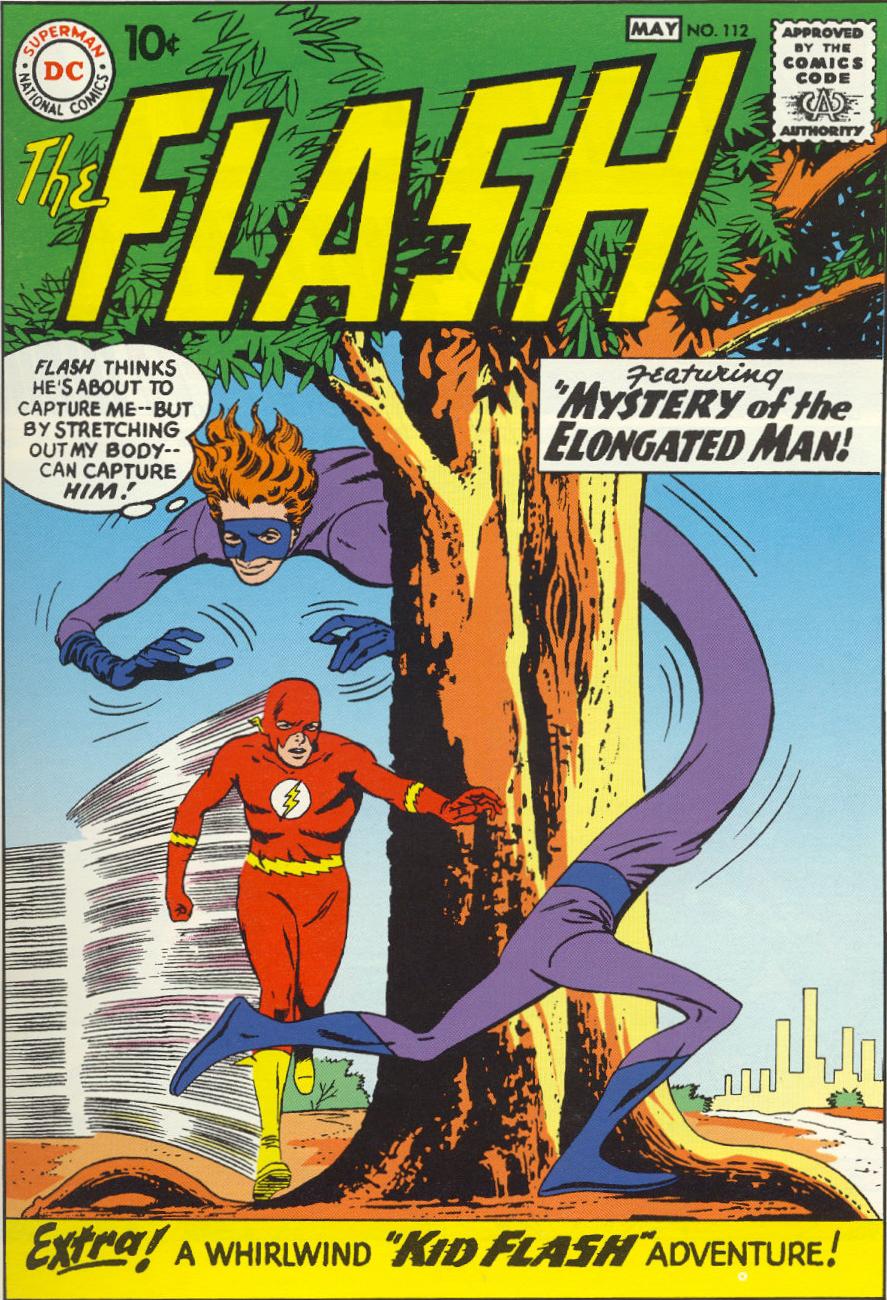
The Flash #112 - "The Mystery of the Elongated Man!" When the Elongated Man arrives in Central City, the Flash is wary of his tendency to help people and getting attention. When he notices some unsolved crimes, he begins to suspect the Elongated Man of committing them.

The Flash #119 - "The Elongated Man's Undersea Trap!" While skin diving on his honeymoon, Ralph disappears. Sue calls in the Flash, who discovers alien fishermen who kidnap humans for slaves.

The Flash #124 - "The Space-Boomerang Trap!" One of the more iconic Flash and Elongated Man team ups. When Captain Boomerang uses time-traveling boomerangs to commit crimes and appear innocent at the same time, it brings the attention of beings from another dimension, forcing Flash and Elongated Man to join forces with the villain.

Detective Comics #327 - "Ten Miles To Nowhere!" The start of Ralph's Detective Comics stories, which continued to #383 before going to irregular appearances. While traveling, Ralph notices that his odometer mysteriously gained ten miles overnight. Investigating, he cracks a crime ring.

Detective Comics #331 - "Museum of Mixed-Up Men!" Ralph's first team up with Batman. Arriving in Gotham City, Ralph joins Batman's investigation of a gang that uses a device that causes people's faces to change.

Detective Comics #355 - "The Tantalizing Trouble of the Tripod Thieves!" Ralph spots jewelry thieves floating away against their will and follows them to discover Zatanna, who winds up enlisting his help in finding her father. This was part of a running story throughout several DC titles that culminated in Justice League of America #51, which Ralph appeared in.

Justice League of America #105 - "Specter in the Shadows!" Ralph is inducted into the Justice League and calls them in when he and Sue witness a gang of putty men raid a museum.

The Flash #252-253 - "Double Dose of Danger!" and "Don't Mess With The Molder!" A two-part story in which Ralph drinks a dose of gingold at super speed when he's recruited by the Flash to investigate a mysterious phantom gang. The "speed-charged" substance causes Ralph to take on the villainous persona of "The Molder," who can change the shape of whatever—or whoever—he touches, part one ending with him reducing the Flash to a puddle on live television.


Detective Comics #500 - "The Final Mystery of Edgar Allan Poe!" Ralph and Sue spot a raven saying "Nevermore!" This leads Ralph to discover an attempted murder, and find a never before published story by Edgar Allan Poe.

Detective Comics #572 - "The Adventure of the Lost Adventure!" Part of a book-long crossover with Batman, Robin and Slam Bradley (and a surprise mystery guest), Ralph foils a plot to steal a long-lost Sherlock Holmes manuscript from 221B Baker Street.

Secret Origins (Vol. 2) #30 - "The Home Stretch." A new version of Ralph's origin based on how the character had developed since his debut, including how he met Sue. It's told in a framing sequence of Ralph returning to his hometown.

Ralph and Sue frequently appeared in Justice League Europe and Justice League International.

Elongated Man #1-4 - 1994 saw Ralph get his very own miniseries. A bit goofy, Ralph and Sue head to Modora where an old Justice League villain attempts to break them apart.
Batman: Gotham Knights #41 - Ralph and Sue meet a very interesting "fan" at a book signing.

Identity Crisis #1-7 - Probably one of the two most controversial stories to include on this list, this story has a huge focus on the Dibnys. Ralph is on a stakeout when he gets an alert from Sue and hurries home, discovering her murdered and the body burned. The other heroes of the DC universe set out to find the killer, revealing disturbing secrets.

Formerly Known As The Justice League #1-6 - A miniseries featuring a comical take on several former League members, including Ralph and Sue. Note that this and its sequel take place prior to Identity Crisis.

JLA Classified #4-9 - "I Can't Believe it's Not The Justice League!" A sequel to Formerly Known As The Justice League.

52 #1-52 - This series follows many characters through the DC universe. Ralph is one of them as he seeks a way to be reunited with Sue after her death in Identity Crisis.

Booster Gold (Vol. 2) #15 - "Reality Lost, Part One" While time traveling, Booster Gold runs into Ralph.

Convergence: Justice League of America #1-2 - Part of the Convergence crossover, this one takes a peek at a world where Ralph and Sue still live, and Ralph is still an active hero.

Secret Six #1-14 (2014-2016) - Ralph and Sue's new incarnations in Earth Prime make their debut as they work to take down the Riddler.

The Various Elongated Man costumes

Well, I ran out of time to do another comic breakdown this week, so here's something different.

I Photoshopped Hartley Sawyer—who will be playing Ralph on The Flash TV show—into each of the five unique costumes the Elongated Man has had over the years. Then I did a second picture of color variations on those costumes. With commentary.

#1 - This first simple purple and pale off-blue color first appeared in Ralph's first appearance in The Flash #112. He wore it with a mask (see inset), but by the time of his move to Detective Comics in #327, he had stopped wearing the mask.

#2 - The red, black and gold costume was revealed on the final pages of Detective Comics #350. A little too-inspired by Plastic Man for my liking, but in 3D, it doesn't look bad actually. Some colorists would switch out the red for purple, especially in Detective Comics #359. The red costume would make a major comeback in early 'naughties, and Ralph was seen in it in the tragic Identity Crisis. Some appearances gave Ralph a V-neck that exposed a bit of his chest.

#3 - The half purple and half white costume seems to have first appeared in Justice League of America #252. One of Ralph's better costumes, in my opinion. In Detective Comics #572, he's wearing it with a matching domino mask. I decided not to do that mask.

#4 - This rather unattractive take on the original costume first appeared in Justice League Europe #37. It made Ralph appear too goofy, in my opinion. Also, in the comics, he looked way too tall and slim in it. Like his head had been stretched out.

#5 - The latest costume appeared at the end of Secret Six #12 in 2016. I didn't like it at first, and I still don't like that it's orange and yellow. I've recolored it in shades of purple, and I like that better. The design is good. Colors, not.


1. A more maroon version of the second costume appeared in several issues of Detective Comics. I'm guessing the colorist decided it looked better. Or maybe since Plastic Man did have a series at the time, perhaps they subtly changed it to avoid confusion.

2. This one is mainly personal. When I was a kid, I would photocopy old comics and recolor these black and white copies, mainly so I'd have my own copy. Since Jimmy Olsen's Elastic Lad did a mainly purple costume with green trunks and Plastic Man had red, I suppose I thought Ralph should have his own color, so given the number of color options I had, I picked green.

3. This one is a personal preference twist on the second costume, but some variations of the second costume in Detective Comics looked more regular purple than maroon or red. See point 1.

4. This bizarre twist of the second costume appeared in Detective Comics #357. It also contains an advertisement for the first issue of the then-new Plastic Man series, so perhaps that lends credence to my theory about them moving away from making it primarily red. Or perhaps the colorist on the story heard that Ralph's costume was "red and yellow" and got confused.

5. My initial reaction to the latest costume was negative, but not for the design, but for the bright orange color. Do not put an orange costume on a character whose hair you color orange. It just looked loud and too flashy and while I'm sure you could make the argument that Ralph would do it for attention or to symbolize a new era in his life, I just prefer purple. So here it is, rendered in purple, which I like much better.

Behold, the Silver Age!

Probably my all time favorite era of comic books is the Silver Age. And frankly, what's not to love?

Comics have simply been an evolution of storytelling through print. Illustration had finally merged with text to tell stories through a visual medium. Crime and war comic books eventually gave rise to the superhero comic book, in which a costumed character would—with or without superpowers—take it upon themselves to thwart evil forces at work in the world. Captain America, Batman, Superman, Wonder Woman, The Flash and Green Lantern were just a handful of characters created in the Golden Age of comics, which is held to have ended in the mid-1950s.

The Golden Age saw many innovations from various comics creators. Virtually any type of character was on the table. Horror comics existed and went in many gruesome and bizarre directions. Subject matter was fairly open, for example, an early Superman story saw him defend a woman against her physically abusive husband by beating him.

People point to many things as starting the Silver Age, but really, I think we have to give a mind to a book titled Seduction of the Innocent, which blamed comic books for youth delinquency and often misinterpreted things in comics as negative. This gave rise to the Comics Code Authority, which was used as a seal on the covers of comics for decades to come to say as to whether or not a comic book met certain guidelines of acceptability. This was not a requirement, of course, but if your comic book didn't have it, good luck getting retailers to sell it, and advertisers might pull their ads.

Comics would be produced by people who cared about them, then read by people, and some of those people might be young kids who decide they wanted to make comics as well and worked to do it. So as comic books continued, they evolved along with the audience. About six years ago, the major comics companies abandoned the Comics Code Authority and it became defunct.

However, back to the Silver Age. Instead of pushing the envelope for the limits of violence and such they could show, in came monsters, aliens and other fantastic events.

In short, they went for stories that could be viewed as fucking crazy.

National Publications (now DC Comics) would be the big one to reintroduce superheroes. New versions of the Flash and the Green Lantern were introduced, and in fact became the standard incarnations of the characters despite being the second heroes with those names. In 1960, they introduced the Justice League of America, in which their biggest heroes would team up. The Flash would eventually introduce the multiverse concept, which allowed for a lot of amazing stories to eventually be written.

Over at Atlas Comics, writer Stanley Leiber (better known as Stan Lee) would be tasked to come up with a team of superheroes, and he and Jack Kirby created The Fantastic Four, debuting in late 1961. Of course, Atlas was soon rebranded to Marvel Comics. This would lead to the creation and reintroduction of many classic Marvel characters, and the introduction of The Avengers. This led to the interconnected Marvel universe, in which many of the superheroes depicted in their line of comics would live in the same version of New York and interact with each other.

So, basically, not only was the Silver Age extremely fun, it basically set the standard for the modern range of superheroes. What's not to love?

So, as you may have noticed, this blog is dedicated to the Elongated Man. He was introduced in 1961, in The Flash (volume 1) #112. He was a character with the power of elasticity, able to stretch his body to superhuman lengths.

The Elongated Man wasn't the first character to have this power. Superman's Pal Jimmy Olsen #58 had the titular character exposed to a liquid kryptonite that allowed him to stretch. But previously, Jack Cole had introduced Plastic Man in Quality Comics' Police Comics in 1941. Plastic Man could stretch and generally reshape his body into any imaginable form, including compressing into small shapes. Quality didn't survive the decline of sales thanks to Seduction of the Innocent and sold many of their characters to National, making Plastic Man one of National's characters.

But was Elongated Man a copycat Plastic Man? According to Brian Cronin of Comic Book Resources, maybe, but unlike the common belief, it's not likely that they would have just used Plastic Man if they'd thought of him.

There is a famous story that Julius Schwartz said that he only came up with the idea for Elongated Man because he didn’t know that DC had the rights to Plastic Man. If he had known, he would have just used Plastic Man (DC had purchased most of Quality Comics characters, including Plastic Man, when Quality went out of business in 1956).

However, I think that Schwartz’s story has been misconstrued a bit over the years.

Schwartz’s recollection of it came years later, when he noted that he didn’t know (or that he had forgotten) that DC had the rights to Plastic Man when he came up with Elongated Man. He did note that perhaps he would have named Elongated Man Plastic Man, but that is just an after-the-fact commentary.

So it really comes down to us determining whether we think that actually would have happened. So this is truly just a case of me having to make a judgment call.

As it was, Elongated Man was a one-off character who was never meant to recur. He turned out to be surprisingly popular with the fans, so they brought him back (and he then proved so popular that they eventually gave him his own feature in Detective Comics). It seems highly unlikely to me that Schwartz would have chosen this particular story to revive Plastic Man.

Carmine Infantino recalled to Jim Amash that Schwartz never actually mentioned Plastic Man at all at the time.

So I believe that even had Schwartz known that DC owned the rights, I don’t think it would have affected the story much. After all, Mort Weisigner had already introduced ANOTHER elastic hero recently at the time (Jimmy Olsen’s Elastic Lad), so it wasn’t like it was out of the ordinary to have an elastic hero other than Plastic Man.

Add in the factor that the Elongated Man's debut story features a plot point of him being suspected to be a criminal and the reappearance of a hero character would spoil the reveal.

Anyway, that's the setting that the Elongated Man was introduced in.

Next time, we're going to look at his first story.

Where Ralph could fit in James Gunn's DCU (and Plastic Man too!)

 So, hi! I haven't forgotten about this blog, it's just time gets away from me, there's other stuff I want to handle. If I could...