Detective Comics #346 has a cover date of December 1965. It's available on Comixology and DC Universe.
In the letters page, Batman continues to dominate the conversation, but there's a few comments on "The Bandits and the Baroness." Robert Allen of Attica, New York thought "the story came out great. Plot, art were all up to par (yawn) and the humor was as terrific as ever. This will go down as an average Elongated Man story but if you keep your average up where it's been (about 99% better than your competitors), then you'll keep my happiness up too."
Mike Friedrich of Castro Valley, California thought Ralph's story was better than Batman's story from the issue. "Elongated Man was far better. Two different sets of crooks working separately, with one trying to rob the other, and six other Ralph Dibnys stretched (if you'll pardon the expression) the story into another winner. It seems like the EM stories are in the same position as Robin is in. Without him backing up the star performer, the latter would be sorely lacking; yet he gets very little publicity or reward for his vital part in the overall setup.
"Incidentally, you (or rather the author) made a minor mistake in the EM story. You called Ralph Dibny the only costumed hero to reveal his other identity. Remember Metamorpho!"
Finally, Ben Creisler of Crescent City, California enthuses about the issue, though doesn't have any specific comments: "And now for that Man of a Million Measurements, that rubberband maker, the Elongated Man! You manage to involve him in a mystery every month and in turn give readers a mystery-to solve, a cascade of thrills."
"Peephole to the Future!" is written by John Broome with Carmine Infantino on art, Sid Greene on inks and Julius Schwartz as editor. The splash page is very eye catching with a nicely drawn Ralph being knocked out, his neck stretching back towards the reader. (And his butt looks very nice in that costume.) The text teases that Ralph has suddenly been able to see into the future. The bank robbers knocking him out say that he suddenly went into a trance and that "He looks so dreamy, he shouldn't mind being put to sleep with this haymaker!"
The story says Ralph and Sue have set up a temporary residence in Empire City. Now, there are a few real Empire Cities in the US, and it's also a nickname for New York City. However, there is an actual Empire City from DC Comics lore. It was the hometown of Manhunter, the second incarnation, who appeared in Adventure Comics during the Golden Age. So, could Ralph and Sue be near the home of an established (but not currently active) superhero? Maybe.
Sue asks Ralph for money to buy a fancy new hat, and he suddenly goes into a trance before giving her an exact sum. She thinks that this more than she wanted to spend, but since Ralph offered, she won't turn it down. I think this should be dialogue, but I suppose it works just as well.
Ralph is suddenly able to predict room service arriving and the phone about to ring and is beginning to be suspicious of his new ability.
Sue is on the phone, excitedly telling Ralph that the hat she bought costs exactly what he gave her. She heads back home and tries on the hat while Ralph is puzzling over his new ability, that he suddenly goes into a trance and sees a quick view of the future. He tries to demonstrate by looking at a newspaper and reads a completely different headline by what's on there. However, Sue doesn't seem to get what he's talking about as he decides to go see if he can stop some bank robbers.
Ah, casual sexism. We know, you've been here the whole time, but now you raise your ugly head again.
Ralph manages to get to the bank in time and manages to stop the robbery by knocking the gun out of the gunman's hand and knocking the crooks over, instructing a clerk to sound the alarm.
However, Ralph has a quick vision of the crooks leaving the bank, and thanks to entering the trance, it allows them to knock him out, now in a much smaller version of the scene from the splash panel. It's not quite as dynamic either. The cramped panels prevent this from being a great Infantino fight scene as well.
The crooks escape out the back as the police arrive. Ralph didn't stop them, but he did prevent the robbery. Back at his hotel room, Sue nurses his sore chin.
The paper Ralph saw is now out, letting Sue see the paper Ralph saw and she mentions that it would've told him that he didn't bring the crooks in.
Meanwhile, the crooks are also reading the paper and see that Ralph was interviewed and mentioned his vision of the future. They decide to try to get even with Ralph and make a profit as well.
Ralph is heading out to perform at a charity bazaar, but when he gets into the elevator, a smoke bomb is tossed in that knocks him out. At the ground floor, the crooks take to their hide out, having chemically weakened Ralph and giving him a truth serum so they can show him the paper and hope to profit from the next day's news. He can't give them stock market predictions or the winning lottery number, but he can see race results, which he gives them and they use it to place bets at the race track and turn $10 into $819,500.
Returning with their wins, one of the remaining crooks reveals he asked Ralph to read him tomorrow's headline, which tells of him capturing them at "George Washington." They decide to go shoot Ralph, but when they enter the room, he's nowhere to be seen.
As they leave, it's revealed that Ralph is hiding between the ceiling tiles, despite feeling very exhausted. He slips down and manages to get to a window, getting some fresh air to restore his strength. (How that works, I don't know.) He manages to stretch his foot down, kick one and knock the others out with his fingers as he descends.
As the police arrive to take the crooks to jail (attempted robbery and kidnapping is still a crime), they see that they were captured at the George Washington Hotel, not the George Washington Bridge as they suspected from the future headline.
Sadly, there's only a litle bit of Ralph fighting the crooks in the story and it's not up to Infantino's usual snuff.
The next day, Sue asks Ralph if it'll be a good day to have a picnic or if it'll rain. Ralph says he doesn't know.
By the way, this panel of Ralph and Sue in their room, Ralph looks particularly attractive.
Ralph goes onto explain that his new super power has vanished. He suspects that there was an impurity in his gingold that he was using at the time.
This is the first instance of something that only comes up once again as far as I know, that if something's wrong with Ralph's gingold, he develops new superpowers in addition to his regular elastic abilities. Given that Ralph was later confirmed to be a metahuman with his elastic powers triggered by gingold, it may be that he actually has several superpowers that he doesn't know how to trigger and the couple of times we saw were times when they were triggered.
The final panel shows Ralph and Sue discovering that it is raining for their picnic after all. Ralph says he'd prefer not to know the future so he can solve mysteries.
Speaking of solving mysteries, this is really just a crime story with some superpowers, no real mystery. Which would be fine, except that this is Detective Comics, so the focus should be on mystery stories. It's really not too bad, despite the casual sexism with how Sue was depicted, but it could've been better if some mystery could've been set up.
Next time, Ralph gets a new costume, but it's not what you think.
Showing posts with label John Broome. Show all posts
Peril in Paris!
Detective Comics #344 has a cover date of October 1965. Once again, it's available on Comixology and DC Universe. This tale was reprinted in the Showcase Presents Elongated Man book.
Over in the letters page, readers were puzzling over the identity of the Outsider from recent Batman stories. It's not until the second column that George Wirth of New Orleans, Louisiana comments on "The Mystery of the Millionaire Cowboy." He thought it was better than the previous story. He calls the story ingenious and the artwork (crediting both Infantino and Greene) great.
Meanwhile, Mark Dillman of Topeka, Kansas found the Batman story from the previous issue "too far-fetched" but thought the Elongated Man story was the best he'd read in months. He then points out that Ralph drives a Mustang in the story unlike previous tales. The editor confirms the fan theory that Ralph and Sue must use rental agencies. Surprisingly, the editor further states that the story was written by John Broome, not Gardner Fox as is reported on many sources.
"Peril in Paris!" was written by John Broome with Carmine Infantino on pencils and Sid Greene on inks. Julius Schwartz served as editor and Joe Letterese lettered it.
The splash page sees men from a boat firing on Ralph, who's just barely visible here. He's supposed to be stretched very thin so they can't hit him, but it looks like a rush job from Infantino and Greene on Ralph when the rest of the page is good. The overly-verbose gunman calls Ralph "L'homme Étendu," which translates to "the Extended Man." Meanwhile, the crowd cheers Ralph on.
How we know this is a John Broome story: the crooks are trying to get away and opening fire with a ton of witnesses present.
Okay, onto the story. The opening text says that Paris is one of Ralph's favorite cities, but this is the first time he's visited with Sue. I suppose he must've visited between his second and third appearances in The Flash. Bit of a stretch there.
Ralph is on the balcony of his Parisian hotel room and spots Sue coming back. That is one weird looking car just past the lamp post in that first panel. Sue returns buzzing that somehow, she can now slip into fluent French despite never having learned it. She's soon able to read the French newspaper as well. It sends Ralph's nose twitching. He continues to read the article about the theft of perfume essence and thinks he'd like to nab the crooks when suddenly, Sue leaves abruptly. Getting a tip from the hotel doorman, Ralph follows her to the Eiffel Tower.
Sue goes over to a couple of men dining at a table and begins to talk to them about a plan. Going over what I can find, they would be at the Champagne Bar at the top of the Eiffel Tower. The men are baffled as they don't recognize Sue, but decide to go question her privately.
Ralph intervenes and Sue claims she doesn't know who Ralph is and he's not her type, and that her name is Monica. At this, the men decide to take her with them and then shove Ralph off of the tower.
For some reason, instead of a more dramatic panel of Ralph falling to what would otherwise be his doom, we get a frankly useless panel of Ralph in mid-air, thinking before we get to the logical next panel of him using his powers to save himself with the crowds below cheering him on.
Also, in the panel where Ralph is saving himself, the scale of the people and the Eiffel Tower looks totally off.
Getting back onto the tower, Ralph uses a pair of sight-seeing mounted binoculars to spot Sue and the crooks heading to a houseboat. Yes, somehow they managed to get to the ground in the mere seconds it took for Ralph to save himself. Ralph descends from the tower and makes a quick bow to the gathered crowd. The panel's art looks a bit less like a bow and more like Ralph is suddenly having a case of food poisoning.
The crooks are baffled about Sue and wondering where their accomplice Monica is. They decide to go on without her, but of course, Ralph is on the trail and pulls the boat back. The crowds watch Ralph as he evades one of the crook's gunfire (a gun inexplicably appears in the crook's hand, but given he's supposed to be a magician, I think it might be a wrist-mounted pistol) by stretching and twisting to dodge the bullets.
Ralph then splashes water onto the boat, then knocks them over and punches them out.
This is definitely not one of Infantino's best fight scenes for Ralph. In fact, I could say it's forgettable. The most interesting panel is the one with Ralph twisted up nearly like rope, but dodging a bullet aside, there's not much else going on.
The crooks are—of course—the perfume essence thieves Ralph read about in the newspaper. A silent Sue is taken by Ralph back to their hotel. Arriving, a strange woman happily greets Ralph and kisses him, making Sue snap out of her reverie and threaten the woman, who is the real Monica.
Monica, being an accomplice of the crooks, is arrested, and Ralph figures that Monica and Sue somehow had their personalities and minds switched when the magician crook hypnotized them. He compares this to Jekyll and Hyde. Sue figures the sight of Monica kissing Ralph was what snapped the two women back to normal. Ralph and Sue go back to touring Paris, with Sue being clueless as to what people are saying in French.
Okay. We have problems here.
We are not told at any point that Sue went to any magic show until Ralph begins piecing things together. Ralph also surmises that Monica is actually the gang leader, so why would she be working in a magic act when she's trying to smuggle high-profile stolen goods?
Hypnosis simply can't do a mind transference, though I know, this is a comic book.
Even Ralph's comparison of Jekyll and Hyde falls apart because Dr. Jekyll and Mr. Hyde weren't body-switching, they were two sides of the same person.
Well, this story is another mess. While Broome was able to handle Ralph all right when he was playing second fiddle to the Flash, he simply can't seem to have him lead a mystery story that hangs together well.
Come back, Gardner Fox. I miss you.
Next time, the crooks who give you money!
Over in the letters page, readers were puzzling over the identity of the Outsider from recent Batman stories. It's not until the second column that George Wirth of New Orleans, Louisiana comments on "The Mystery of the Millionaire Cowboy." He thought it was better than the previous story. He calls the story ingenious and the artwork (crediting both Infantino and Greene) great.
Meanwhile, Mark Dillman of Topeka, Kansas found the Batman story from the previous issue "too far-fetched" but thought the Elongated Man story was the best he'd read in months. He then points out that Ralph drives a Mustang in the story unlike previous tales. The editor confirms the fan theory that Ralph and Sue must use rental agencies. Surprisingly, the editor further states that the story was written by John Broome, not Gardner Fox as is reported on many sources.
"Peril in Paris!" was written by John Broome with Carmine Infantino on pencils and Sid Greene on inks. Julius Schwartz served as editor and Joe Letterese lettered it.
The splash page sees men from a boat firing on Ralph, who's just barely visible here. He's supposed to be stretched very thin so they can't hit him, but it looks like a rush job from Infantino and Greene on Ralph when the rest of the page is good. The overly-verbose gunman calls Ralph "L'homme Étendu," which translates to "the Extended Man." Meanwhile, the crowd cheers Ralph on.
How we know this is a John Broome story: the crooks are trying to get away and opening fire with a ton of witnesses present.
Okay, onto the story. The opening text says that Paris is one of Ralph's favorite cities, but this is the first time he's visited with Sue. I suppose he must've visited between his second and third appearances in The Flash. Bit of a stretch there.
Ralph is on the balcony of his Parisian hotel room and spots Sue coming back. That is one weird looking car just past the lamp post in that first panel. Sue returns buzzing that somehow, she can now slip into fluent French despite never having learned it. She's soon able to read the French newspaper as well. It sends Ralph's nose twitching. He continues to read the article about the theft of perfume essence and thinks he'd like to nab the crooks when suddenly, Sue leaves abruptly. Getting a tip from the hotel doorman, Ralph follows her to the Eiffel Tower.
Sue goes over to a couple of men dining at a table and begins to talk to them about a plan. Going over what I can find, they would be at the Champagne Bar at the top of the Eiffel Tower. The men are baffled as they don't recognize Sue, but decide to go question her privately.
Ralph intervenes and Sue claims she doesn't know who Ralph is and he's not her type, and that her name is Monica. At this, the men decide to take her with them and then shove Ralph off of the tower.
For some reason, instead of a more dramatic panel of Ralph falling to what would otherwise be his doom, we get a frankly useless panel of Ralph in mid-air, thinking before we get to the logical next panel of him using his powers to save himself with the crowds below cheering him on.
Also, in the panel where Ralph is saving himself, the scale of the people and the Eiffel Tower looks totally off.
Getting back onto the tower, Ralph uses a pair of sight-seeing mounted binoculars to spot Sue and the crooks heading to a houseboat. Yes, somehow they managed to get to the ground in the mere seconds it took for Ralph to save himself. Ralph descends from the tower and makes a quick bow to the gathered crowd. The panel's art looks a bit less like a bow and more like Ralph is suddenly having a case of food poisoning.
The crooks are baffled about Sue and wondering where their accomplice Monica is. They decide to go on without her, but of course, Ralph is on the trail and pulls the boat back. The crowds watch Ralph as he evades one of the crook's gunfire (a gun inexplicably appears in the crook's hand, but given he's supposed to be a magician, I think it might be a wrist-mounted pistol) by stretching and twisting to dodge the bullets.
Ralph then splashes water onto the boat, then knocks them over and punches them out.
This is definitely not one of Infantino's best fight scenes for Ralph. In fact, I could say it's forgettable. The most interesting panel is the one with Ralph twisted up nearly like rope, but dodging a bullet aside, there's not much else going on.
The crooks are—of course—the perfume essence thieves Ralph read about in the newspaper. A silent Sue is taken by Ralph back to their hotel. Arriving, a strange woman happily greets Ralph and kisses him, making Sue snap out of her reverie and threaten the woman, who is the real Monica.
Monica, being an accomplice of the crooks, is arrested, and Ralph figures that Monica and Sue somehow had their personalities and minds switched when the magician crook hypnotized them. He compares this to Jekyll and Hyde. Sue figures the sight of Monica kissing Ralph was what snapped the two women back to normal. Ralph and Sue go back to touring Paris, with Sue being clueless as to what people are saying in French.
Okay. We have problems here.
We are not told at any point that Sue went to any magic show until Ralph begins piecing things together. Ralph also surmises that Monica is actually the gang leader, so why would she be working in a magic act when she's trying to smuggle high-profile stolen goods?
Hypnosis simply can't do a mind transference, though I know, this is a comic book.
Even Ralph's comparison of Jekyll and Hyde falls apart because Dr. Jekyll and Mr. Hyde weren't body-switching, they were two sides of the same person.
Well, this story is another mess. While Broome was able to handle Ralph all right when he was playing second fiddle to the Flash, he simply can't seem to have him lead a mystery story that hangs together well.
Come back, Gardner Fox. I miss you.
Next time, the crooks who give you money!
The Secret War of the Phantom General
Detective Comics #343 was released with a cover date of September, 1965. It can be found on Comixology and DC Universe. In addition, since this story also features Batman, it has been reprinted in Batman Family (Vol. 1) #4 and Showcase Presents: Batman Vol 2, as well as Showcase Presents Elongated Man.
Over in the letters page, readers were too busy puzzling over how Batman could actually lift a gorilla on the cover of #339 to discuss Ralph's story in that issue. However, Joel Pollack of Silver Spring, Maryland tries to offer advice on how to identify inkers on Carmine Infantino's work throughout the book. "I can sum it up in one word—expression. When Sid Greene inks Carmine Infantino, everyone looks happy, even when they're sad. With Joe Giella, everyone looks befuddled. When Infantino pencils, characters have very human expressions on their faces."
This would be the second team up story for Batman and Ralph, following from "Museum of Mixed-Up Men!" back in #331. The concept was to do a book-length story occasionally pairing up the two heroes instead of two separate stories. Readers weren't crazy about it, though.
"The Secret War of the Phantom General" would see the return of John Broome to writing for Ralph and Joe Giella on ink with Carmine Infantino on pencils and Ira Schnapp lettering. Julius Schwartz was editor.
The cover should be striking, but something about it just feels unappealing to me. Ralph seemingly has Batman and Robin at his mercy, tied up in his arms, at the command of the ghostly face behind them. I'm going to venture that it would look much better against an actual background instead of black, empty space.
Another error is the text on the cover and header trying to suggest that the villain of the story might not actually be alive, but they show him standing right there in the splash panel.
We haven't even started the story, and I'm already disappointed.
So yes, the splash panel shows us the villain General Von Dort with a hypnotic monocle that has put Ralph and Robin out of action with Batman trying very hard not to look to avoid the same fate. It's interesting and very Batman-central and Joe Giella returning to ink Ralph again looks okay.
Ralph doesn't turn up until page 6, so I'll sum up the story until then.
Batman and Robin are going to meet Ralph and Sue at a hotel when they hear about a hold up at the Gotham City Terminal. There are dozens of crooks and when Batman and Robin arrive, they only manage to take out a few before most of them escape. Batman notes military-style efficiency and a reporter decides to run "Is New Mystery Crime King A Military Mastermind?"
Batman and Robin go on to meet Ralph and Sue, the latter of which goes to the Gotham City Music Hall to go offscreen until the final panel of the story. (Sigh.)
Batman tells Ralph about the scene they just arrived from and when he mentions "military mastermind," Ralph freaks out and goes pale. He tries to connect dots as the story cuts away to a flashback introduced by a portrait of John Broome.
The flashback shows some Gotham City criminals being met by General Van Dort, a German general who was believed to be dead "with Hitler in that fatal Berlin bunker!" Van Dort says he's alive and has simply moved from traditional warfare to crime. He wants to take over the crime world in Gotham and claims he can't fail. When one crook asks him how he knows they won't turn him over to the police, he laughs and stares them with his monocle and says they wouldn't dare.
Seriously, I hate that we got this method of introducing the villain. The cover and title teases that the General might be dead and it's his ghost. Here, page 8, Van Dort clearly says that this isn't the case. While our protagonists might not know, we as an audience do, so that bit of suspense is gone. It's also really clumsy to have Ralph freak out and then there's no explanation for what happened for two pages.
Ralph explains that he was in South America and heard rumors about Van Dort. He heard that Van Dort left his base in the Andes for Gotham, which makes his freak out so surprising. Now that Batman and Robin have an idea of who they're dealing with, they all set out to investigate together.
The last panel shows Ralph putting his costume on. I'm going to assume he's finishing putting on after stepping out of the bathroom and he didn't strip down in front of Batman and Robin.
While out, Batman and Robin spot parachuting crooks descending on an auction and go break them up. However, these crooks were just a diversion while Van Dort steals an undisclosed item and heads back to the Andes.
As the heroes meet up again, absent until now Ralph reveals that he has discovered that Van Dort was working on a Death Ray, and was only lacking "a vital radioactive isotope called M-244." They realize that Van Dort has stolen the isotope and headed back to the Andes, so they head to Batplane to pursue.
Arriving, Ralph stretches his neck from the Batplane so he can strike a sniper. Good going, Ralph, it's about time that you got an action moment.
As the three heroes meet and take on Van Dort's men, they are identified as Batman and Robin. Ralph adds "And don't forget the Elongated Man!" Okay, that's a good moment.
Ralph spots Von Dort through a window and stretches in to demand his surrender. Von Dort uses his monocle and compels Ralph to turn on Batman and Robin. Ralph seems to be completely aware of what he's doing, but he can't stop his actions.
Batman and Robin manage to stop Ralph by twisting his arms around himself and squeeze him, making Von Dort's spell on him break.
So... What the heck just happened? Did Batman and Robin break a weird trance by forcing Ralph into a self-induced Heimlich maneuver?
Von Dort himself arrives on the scene and freezes Robin with the radiation from his monocle, and Batman—observing Von Dort's weapon—lowers his head and charges, knocking Von Dort out with a punch.
Why would a military mastermind like Von Dort just arrive on scene with no protection? Like, do it from the window and then go to escape or something. It's like he wasn't even trying.
Before I go to the final panels, this surprisingly wasn't the end of Von Dort. Five years later, Batman would face his son Willi Van Dort (they got the name wrong) along with Wonder Woman in The Brave and the Bold #87.
Batman and Robin get the authorities to pick up Von Dort and his crew and discuss how his monocle worked and how they narrowly stopped his death ray.
Later, Batman and Robin join Ralph and Sue in their hotel room for tea, Batman thinking that nothing ruffles Sue. (Lies.) "Just looking at her makes you realize that everything's all right in the world—and probably always will be!"
Well, that makes Identity Crisis hurt even more.
You know, I think it'd be fun if Sue has figured out that Bruce Wayne is Batman from observing Batman's mannerisms here while he's at ease and putting together what she probably knows about Bruce Wayne.
Well, I'm rather disappointed with this story. The lead in text, cover and title all tease that Von Dort might be dead, but it's quickly shown to not be the case and Batman and Robin take him down with just a bit of help from Ralph, who's definitely just a guest star here. The story idea of an former Nazi general finishing a death ray is not bad, but it's not carried to its full potential here. The wrap up is contrived and just too easy. It's too bad John Broome doesn't seem to care about Ralph very much after he introduced him back in The Flash. The best moment is the bit where Ralph announces himself to Von Dort's men.
Infantino's art is fine with some well-done moments, but nothing really spectacular.
Next time, Ralph goes to Paris.
Over in the letters page, readers were too busy puzzling over how Batman could actually lift a gorilla on the cover of #339 to discuss Ralph's story in that issue. However, Joel Pollack of Silver Spring, Maryland tries to offer advice on how to identify inkers on Carmine Infantino's work throughout the book. "I can sum it up in one word—expression. When Sid Greene inks Carmine Infantino, everyone looks happy, even when they're sad. With Joe Giella, everyone looks befuddled. When Infantino pencils, characters have very human expressions on their faces."
This would be the second team up story for Batman and Ralph, following from "Museum of Mixed-Up Men!" back in #331. The concept was to do a book-length story occasionally pairing up the two heroes instead of two separate stories. Readers weren't crazy about it, though.
"The Secret War of the Phantom General" would see the return of John Broome to writing for Ralph and Joe Giella on ink with Carmine Infantino on pencils and Ira Schnapp lettering. Julius Schwartz was editor.
The cover should be striking, but something about it just feels unappealing to me. Ralph seemingly has Batman and Robin at his mercy, tied up in his arms, at the command of the ghostly face behind them. I'm going to venture that it would look much better against an actual background instead of black, empty space.
Another error is the text on the cover and header trying to suggest that the villain of the story might not actually be alive, but they show him standing right there in the splash panel.
We haven't even started the story, and I'm already disappointed.
So yes, the splash panel shows us the villain General Von Dort with a hypnotic monocle that has put Ralph and Robin out of action with Batman trying very hard not to look to avoid the same fate. It's interesting and very Batman-central and Joe Giella returning to ink Ralph again looks okay.
Ralph doesn't turn up until page 6, so I'll sum up the story until then.
Batman and Robin are going to meet Ralph and Sue at a hotel when they hear about a hold up at the Gotham City Terminal. There are dozens of crooks and when Batman and Robin arrive, they only manage to take out a few before most of them escape. Batman notes military-style efficiency and a reporter decides to run "Is New Mystery Crime King A Military Mastermind?"
Batman and Robin go on to meet Ralph and Sue, the latter of which goes to the Gotham City Music Hall to go offscreen until the final panel of the story. (Sigh.)
Batman tells Ralph about the scene they just arrived from and when he mentions "military mastermind," Ralph freaks out and goes pale. He tries to connect dots as the story cuts away to a flashback introduced by a portrait of John Broome.
The flashback shows some Gotham City criminals being met by General Van Dort, a German general who was believed to be dead "with Hitler in that fatal Berlin bunker!" Van Dort says he's alive and has simply moved from traditional warfare to crime. He wants to take over the crime world in Gotham and claims he can't fail. When one crook asks him how he knows they won't turn him over to the police, he laughs and stares them with his monocle and says they wouldn't dare.
Seriously, I hate that we got this method of introducing the villain. The cover and title teases that the General might be dead and it's his ghost. Here, page 8, Van Dort clearly says that this isn't the case. While our protagonists might not know, we as an audience do, so that bit of suspense is gone. It's also really clumsy to have Ralph freak out and then there's no explanation for what happened for two pages.Ralph explains that he was in South America and heard rumors about Van Dort. He heard that Van Dort left his base in the Andes for Gotham, which makes his freak out so surprising. Now that Batman and Robin have an idea of who they're dealing with, they all set out to investigate together.
The last panel shows Ralph putting his costume on. I'm going to assume he's finishing putting on after stepping out of the bathroom and he didn't strip down in front of Batman and Robin.
While out, Batman and Robin spot parachuting crooks descending on an auction and go break them up. However, these crooks were just a diversion while Van Dort steals an undisclosed item and heads back to the Andes.
As the heroes meet up again, absent until now Ralph reveals that he has discovered that Van Dort was working on a Death Ray, and was only lacking "a vital radioactive isotope called M-244." They realize that Van Dort has stolen the isotope and headed back to the Andes, so they head to Batplane to pursue.Arriving, Ralph stretches his neck from the Batplane so he can strike a sniper. Good going, Ralph, it's about time that you got an action moment.
As the three heroes meet and take on Van Dort's men, they are identified as Batman and Robin. Ralph adds "And don't forget the Elongated Man!" Okay, that's a good moment.
Ralph spots Von Dort through a window and stretches in to demand his surrender. Von Dort uses his monocle and compels Ralph to turn on Batman and Robin. Ralph seems to be completely aware of what he's doing, but he can't stop his actions.
Batman and Robin manage to stop Ralph by twisting his arms around himself and squeeze him, making Von Dort's spell on him break.
So... What the heck just happened? Did Batman and Robin break a weird trance by forcing Ralph into a self-induced Heimlich maneuver?
Von Dort himself arrives on the scene and freezes Robin with the radiation from his monocle, and Batman—observing Von Dort's weapon—lowers his head and charges, knocking Von Dort out with a punch.
Why would a military mastermind like Von Dort just arrive on scene with no protection? Like, do it from the window and then go to escape or something. It's like he wasn't even trying.
Before I go to the final panels, this surprisingly wasn't the end of Von Dort. Five years later, Batman would face his son Willi Van Dort (they got the name wrong) along with Wonder Woman in The Brave and the Bold #87.
Batman and Robin get the authorities to pick up Von Dort and his crew and discuss how his monocle worked and how they narrowly stopped his death ray.
Later, Batman and Robin join Ralph and Sue in their hotel room for tea, Batman thinking that nothing ruffles Sue. (Lies.) "Just looking at her makes you realize that everything's all right in the world—and probably always will be!"
Well, that makes Identity Crisis hurt even more.
You know, I think it'd be fun if Sue has figured out that Bruce Wayne is Batman from observing Batman's mannerisms here while he's at ease and putting together what she probably knows about Bruce Wayne.
Well, I'm rather disappointed with this story. The lead in text, cover and title all tease that Von Dort might be dead, but it's quickly shown to not be the case and Batman and Robin take him down with just a bit of help from Ralph, who's definitely just a guest star here. The story idea of an former Nazi general finishing a death ray is not bad, but it's not carried to its full potential here. The wrap up is contrived and just too easy. It's too bad John Broome doesn't seem to care about Ralph very much after he introduced him back in The Flash. The best moment is the bit where Ralph announces himself to Von Dort's men.
Infantino's art is fine with some well-done moments, but nothing really spectacular.
Next time, Ralph goes to Paris.
Mystery of the Millionaire Cowboy!
June 1965 brought Detective Comics #340, featuring Ralph's next adventure, "Mystery of the Millionaire Cowboy!" The issue is available on Comixology and DC Universe, but has only been reprinted in Showcase Presents The Elongated Man.
In the letters page, reader Walt Smith says they preferred Ralph's story to Batman's in #336, "The House of 'Flashy' Traps!" Why? The Flash pops up, and Walt feels that seeing heroes interact outside of The Justice League of America "makes your characters more realistic." Looking back at it now, it seems like faint praise, but I suppose it wasn't common back then, spurring Walt's letter. There's two other letters, but they only comment on Batman's story.
This story was written by John Broome with Carmine Infantino on pencils, Sid Greene on inks, Gaspar Saladino on lettering and Julius Schwartz credited as editor.
The splash page shows Ralph hanging from some rings in a gym as two crooks stretch out his legs, thinking they "got him." The dialogue from Ralph's thought bubble can be read as Ralph being dismissive or wondering if the crooks have a trick up their sleeve. Anyway, Infantino does a fine splash panel. Not exactly eye-catching, though.
The story is set in Midwest City, which says it's famous for culture and night life. There is a real Midwest City in Oklahoma, and currently, it does seem to have quite the night life. I can't tell if it was the same back in 1965, or if Fox just put the name in there because he needed to name the city.
Ralph surprises Sue with tickets to a show titled "A Satellite For Two." While the show was sold out, the theater just added two new balcony seats, which a friend of Ralph's who's in the show managed to procure for him.
Sue puts on a new red dress that Ralph, being extremely cute, admires her in, even elongating his eyes to make them "pop." Infantino is in usual good form, telling the story well in the quick pace the Silver Age used.
Arriving at the theater, Ralph and Sue notice crowds of people who are likely being turned away due to the show being sold out. Getting to their seats, though, they notice that they are the only audience members in attendance. Ralph confirms it by elongating his neck and looking around the seats.
We get a peek of the opening number, introduced by a man dressed as an astronaut saying, "The future is ours, baby! Listen..." Then the song begins "I'll be alone with you in a satellite built for two!"
But... satellites weren't made to carry people...
Ralph's mystery-sniffing nose is set off as the song finishes and applause can be clearly heard. Sure enough, Ralph slips away to investigate, leaving Sue to watch the show on her own.
The story shifts over to an elaborate mansion owned by Mr. Hurd "a wealthy cattleman," who is the titular "Millionaire Cowboy." A group of crooks are demanding he gives them his money or they'll blow the place up. Which seems a little dumb as it'd be unusual for a millionaire to have his money in cash form and not, you know, in a bank or tied up in stocks. The story actually never says he has his money there, so I'm just going to assume the crooks are really stupid.
Mr. Hurd and his wife stall the crooks by playing a game of "cold beans, hot beans" with them, where Mr. Hurd will say they're cold if they're not close to finding the money, or "warm" or "hot" if they're close. They walk past his pool and into a gym, where Hurd claims one guy is getting "hot," and the crook opens a panel on a wall, where a boxing glove springs out and punches him. The crooks are mad and figure they've been had and throw some dynamite into a sitting room.
Luckily, Ralph has arrived and manages to quickly deposit the dynamite into an old, abandoned well, where it harmlessly explodes. He slips into the sitting room and the crooks look back in to find him when they realize the explosion was too far off.
Note that the panel in which the crooks discover Ralph suffers from the recurring problem of the colorist adding in the line of Ralph's collar.
Now we get to the moment from the splash page where the crooks are stretching out Ralph's legs, intending to "stretch him out" in opposite directions, but as soon as they're next to walls, Ralph simply kicks and knocks them out. A footnote explains that Ralph's limit of elasticity is about "100 yards" or 300 feet. Of course, this limit is hardly going to be religiously followed by everyone.
When another crook tries to shoot Ralph, he quickly coils his leg around them, wrapping them up. The other two crooks begin to recover, but Ralph quickly knocks them out by extending his elbows.
The police are called in and take away the crooks while Ralph talks to Mr. Hurd and his wife. Ralph of course asked the front desk about the empty theater and found out that Mr. Hurd had bought out the theater, so Ralph went to his home to investigate.
Mr. Hurd explains that he wanted to see a hit show along with his wife, so they bought out the theater. But for the benefit of the actors, they would play applause from concealed loudspeakers during the show. Of course, the crooks had kept them from attending. However, Mr. Hurd makes a call and promises a nice payout to the cast of the show if they can do another performance, letting Ralph see the show.
The final panel sees the two couples having front row seats, with Mr. Hurd promising to take the Dibnys to the "swankiest" night club in town. Sue decides she'll slip away this time to change into something more formal. After all, she already saw the show earlier.
This story isn't especially great, but it has a good plot. The only thing is just how stupid are those crooks? There wasn't much to say about the art because Infantino did a great job. Ralph's fight with the crooks isn't his most spectacular fight, but it's serviceable.
Next time, Ralph meets the Elongated Man.
In the letters page, reader Walt Smith says they preferred Ralph's story to Batman's in #336, "The House of 'Flashy' Traps!" Why? The Flash pops up, and Walt feels that seeing heroes interact outside of The Justice League of America "makes your characters more realistic." Looking back at it now, it seems like faint praise, but I suppose it wasn't common back then, spurring Walt's letter. There's two other letters, but they only comment on Batman's story.
This story was written by John Broome with Carmine Infantino on pencils, Sid Greene on inks, Gaspar Saladino on lettering and Julius Schwartz credited as editor.
The splash page shows Ralph hanging from some rings in a gym as two crooks stretch out his legs, thinking they "got him." The dialogue from Ralph's thought bubble can be read as Ralph being dismissive or wondering if the crooks have a trick up their sleeve. Anyway, Infantino does a fine splash panel. Not exactly eye-catching, though.
The story is set in Midwest City, which says it's famous for culture and night life. There is a real Midwest City in Oklahoma, and currently, it does seem to have quite the night life. I can't tell if it was the same back in 1965, or if Fox just put the name in there because he needed to name the city.
Ralph surprises Sue with tickets to a show titled "A Satellite For Two." While the show was sold out, the theater just added two new balcony seats, which a friend of Ralph's who's in the show managed to procure for him.
Sue puts on a new red dress that Ralph, being extremely cute, admires her in, even elongating his eyes to make them "pop." Infantino is in usual good form, telling the story well in the quick pace the Silver Age used.
Arriving at the theater, Ralph and Sue notice crowds of people who are likely being turned away due to the show being sold out. Getting to their seats, though, they notice that they are the only audience members in attendance. Ralph confirms it by elongating his neck and looking around the seats.
We get a peek of the opening number, introduced by a man dressed as an astronaut saying, "The future is ours, baby! Listen..." Then the song begins "I'll be alone with you in a satellite built for two!"
But... satellites weren't made to carry people...
Ralph's mystery-sniffing nose is set off as the song finishes and applause can be clearly heard. Sure enough, Ralph slips away to investigate, leaving Sue to watch the show on her own.
The story shifts over to an elaborate mansion owned by Mr. Hurd "a wealthy cattleman," who is the titular "Millionaire Cowboy." A group of crooks are demanding he gives them his money or they'll blow the place up. Which seems a little dumb as it'd be unusual for a millionaire to have his money in cash form and not, you know, in a bank or tied up in stocks. The story actually never says he has his money there, so I'm just going to assume the crooks are really stupid.Mr. Hurd and his wife stall the crooks by playing a game of "cold beans, hot beans" with them, where Mr. Hurd will say they're cold if they're not close to finding the money, or "warm" or "hot" if they're close. They walk past his pool and into a gym, where Hurd claims one guy is getting "hot," and the crook opens a panel on a wall, where a boxing glove springs out and punches him. The crooks are mad and figure they've been had and throw some dynamite into a sitting room.
Luckily, Ralph has arrived and manages to quickly deposit the dynamite into an old, abandoned well, where it harmlessly explodes. He slips into the sitting room and the crooks look back in to find him when they realize the explosion was too far off.
Note that the panel in which the crooks discover Ralph suffers from the recurring problem of the colorist adding in the line of Ralph's collar.
Now we get to the moment from the splash page where the crooks are stretching out Ralph's legs, intending to "stretch him out" in opposite directions, but as soon as they're next to walls, Ralph simply kicks and knocks them out. A footnote explains that Ralph's limit of elasticity is about "100 yards" or 300 feet. Of course, this limit is hardly going to be religiously followed by everyone.
When another crook tries to shoot Ralph, he quickly coils his leg around them, wrapping them up. The other two crooks begin to recover, but Ralph quickly knocks them out by extending his elbows.
The police are called in and take away the crooks while Ralph talks to Mr. Hurd and his wife. Ralph of course asked the front desk about the empty theater and found out that Mr. Hurd had bought out the theater, so Ralph went to his home to investigate.
Mr. Hurd explains that he wanted to see a hit show along with his wife, so they bought out the theater. But for the benefit of the actors, they would play applause from concealed loudspeakers during the show. Of course, the crooks had kept them from attending. However, Mr. Hurd makes a call and promises a nice payout to the cast of the show if they can do another performance, letting Ralph see the show.
The final panel sees the two couples having front row seats, with Mr. Hurd promising to take the Dibnys to the "swankiest" night club in town. Sue decides she'll slip away this time to change into something more formal. After all, she already saw the show earlier.
This story isn't especially great, but it has a good plot. The only thing is just how stupid are those crooks? There wasn't much to say about the art because Infantino did a great job. Ralph's fight with the crooks isn't his most spectacular fight, but it's serviceable.
Next time, Ralph meets the Elongated Man.
The Pied Piper's Double Doom!
Ralph's last appearance in The Flash for nearly eight years was in #138. Nine months after this issue, Ralph moved to a solo backup feature in Detective Comics, but we'll get on the details of that next time.
Seeing Ralph out of the book he debuted in was of course the same team that saw him appear: John Broome writing, Carmine Infantino on art, and Joe Giella on inks.
The front cover continues the tradition of turning a panel in the story into the cover, with a layout change, of course. And this is certainly quite the dynamic cover with how the Pied Piper is directly in the middle with the two heroes clearly in his power. Also, Infantino is clearly having fun with Ralph's body by fitting it around that text, likely the work of Mr. Gaspar Saladino. (But since work went uncredited at the time, it's difficult to pin down exactly who did the lettering for a lot of these comics.)
On to the splash page! Using a three-panel design, the text and image tantalize us with what's to come in the story. Even without the text, the motion indicated in the artwork already suggests that Ralph and Barry are being influenced by the Pied Piper to commit crime somehow.
The story opens with two guards making sure no one enters the Tower of Tower City, which must be near Central City. The text indicates that the Tower was basically a fortress that settlers used to fight off "Indians" three hundred years ago when it was just Tower Town. For some reason, instead of upkeeping the original tower, it's been rebuilt. Well, I guess it was 300 years ago.
Even more bafflingly, a monarch of an undisclosed European country has loaned their royal jewels to Tower City and they're keeping them in the top of the Tower. Under guard, of course. I guess the Tower is the museum they got. But bafflingly, the jewels have been stolen when the story properly starts.
The page cuts to the Pied Piper, who is admiring the Star of India, the stolen gem and thinking about how clever he is to use superheroes as his "plundering puppets." I like that his thoughts use alliterative words.
On this page, we see the Piper's previous plot to steal the Star of India in action as he recognizes Ralph Dibny in a crowd at Tower Town. Using a small pipe, he programs Ralph to do his bidding, which he did the previous night, playing a special turne that makes Ralph leave his hotel room and use his stretching powers to cross the moat and reach up to the top of the Tower.
This is a really good flashback page. Note the jagged edges around the panels and the profile of the Piper on the left side giving us the idea that this isn't happening in the present, but the past.
You'll notice a woman near Ralph in the first two main panels, which seems to match Sue as we see her later in the story. So they at least don't forget her anymore.
The next page shows Ralph breaking in to steal the jewels, smashing the case, which is a surprise that it doesn't alert the guard who's standing right outside. The page is particularly creepy, which is good since it's featuring Ralph acting out of character. The Piper has Ralph turn the loot over to him, then wipes his memory of what he's just done.
It's important to note that this would be mind control, not hypnosis. Hypnosis only offers suggestions or helps to dig up memories. Mind control in this sense is basically science fiction and can be depicted however they want.
Ralph reads of the mysterious crimes in the paper, with Sue realizing he'll be off on a case in a moment. This is basically going to be the template for their cases in Detective Comics. Surprisingly, they happen to have a double date with Barry Allen and Iris West that night. Iris and Sue will spend the day shopping. Also something we'll see more of in the future...
Infantino draws the Dibnys as a fairly sweet and loving couple and it's still amazing how much motion he manages to depict in these still images. Sue herself is particularly glamorous, and you can easily pick up on the idea that they love each other very much and that they're from very different backgrounds.
Barry begins investigating the Tower City robbery, but while he's at the tower, the Piper puts him under mind control as well and has him rob the Tower City bank at super speed, so fast no one sees it happen. He boasts at his control of Barry for an hour before sending him back to the Tower and wiping his memory. The only thing is, Barry does the robbery at super speed, but finds the Piper back in his hideout in his standard garb. How did the Piper have enough time to get back, much less change clothes?
Barry has noticed footprints that are too far apart for any normal human, and finding Ralph at the Tower City Bank, he tells him that only he could have committed the robbery at the Tower. (I guess the DC staff hadn't yet decided Plastic Man existed in this world or Barry doesn't know about Jimmy Olsen as Elastic Lad.)
I'm pretty sure at the time of writing this story, it wasn't the plan for Ralph to move into a backup feature in Detective Comics and the plan was that he'd be back in the The Flash, but in this moment, we have an echo to his first appearance where Barry suspects he might be responsible for crimes. And it just so happens that it's his last regular guest star appearance for a very long time. So, this moment serves as nearly a fitting bookend for this chapter of Ralph's appearances in The Flash.
Ralph informs Barry that the clocks stopped in mere milliseconds from each other. The only one who could move that fast would be Barry himself.
The two realize they must have been forced to do these robberies and forget, which is a totally reasonable line of thought. They go back to Ralph's hotel room, where they decide to take precautions if it ever happens again.
The two heroes paint the soles of their feet with special paint that'll leave infra-red traces for them to follow. I love how Ralph has elongated his leg to easily paint his foot, just showing off what he can do with his powers.
Barry then asks Ralph for some gingold, which he claims should allow him to stretch. Given what's revealed about gingold later, this shouldn't work, but because it's only been established that it gives people elastic powers, it works just fine.
Ralph notes that a half hour vanishes as Barry drinks the gingold, meaning they've been made to do another crime. They leap into action with the infra-red lamp, showing their prints.
I really hope The Flash TV show has Ralph ride on Barry's shoulders sometime. It's a classic position for them.
The Piper is informed of Ralph and Barry arriving by his "musical radar system." If you're going to balk at a musical radar that has specific alarms for the wavelengths of the heroes, you just haven't been paying much attention. It's the Silver Age, after all.
Being alerted to the heroes arriving, the Piper steps outside and uses his mind control to make Ralph stretch and twist himself into a super long corkscrew, and this is of course where the scene depicted on the cover comes from. Barry runs on empty air as if he's stuck on a treadmill. Because gravity doesn't matter with super speed.
Infantino of course draws this absolutely insane sequence with nearly cinematic visuals.
Using the powers granted him by gingold, Barry manages to stretch his arm and knock the pipes away from Piper, breaking his control of the heroes. He runs back inside to get another pair of pipes because he forgets that he's up against someone with super speed.
Barry stops to help Ralph untwist himself, which causes a small tornado due to Barry doing it at super speed. This wrecks the Piper's house, preventing him from using another pair of pipes, Ralph snatching him out at the last minute. Barry then stops the tornado from damaging anything else in the city.
Ralph manages to meet Iris and Sue in time for their double date, but Barry arrives ten minutes late, due to dealing with reporters at the police station and returning the stolen goods to their owners. Iris gives him a tongue lashing, but what can he do?
Ralph and Sue totally know Barry's the Flash, right? Why else would they pair up with Barry and Iris—a police scientist and a reporter—for a double date?
So, here we are at the end of Ralph's appearances in The Flash as a guest star for awhile. When he returns to the pages of The Flash in #206, it's only for a small run of backup stories. I wish I had the story of why they decided to give Ralph his backup in Detective Comics and why five solo stories ran in The Flash. If anyone knows, feel free to drop a comment.
But what about this story? Frankly... it's a fun story at first glance. When examined closely, it begins to show some glaring weaknesses. Suddenly Piper must also have super speed to do some of the things that he does. I'm not sure why Barry had to stop to help Ralph recover instead of letting him snap back to normal instead of just apprehending the Pied Piper. But hey, we wouldn't have gotten those cool panels with the tornado that I didn't show you.
So, once again, we get some "nerfing" going on in a team up, though it's not quite as glaringly bad. Perhaps this is why Ralph disappeared from The Flash for so long: they were having trouble coming up with stories that used him without becoming a detriment to both characters. But hey, we got more Sue!
Next time, we get to Detective Comics at last.
Seeing Ralph out of the book he debuted in was of course the same team that saw him appear: John Broome writing, Carmine Infantino on art, and Joe Giella on inks.
The front cover continues the tradition of turning a panel in the story into the cover, with a layout change, of course. And this is certainly quite the dynamic cover with how the Pied Piper is directly in the middle with the two heroes clearly in his power. Also, Infantino is clearly having fun with Ralph's body by fitting it around that text, likely the work of Mr. Gaspar Saladino. (But since work went uncredited at the time, it's difficult to pin down exactly who did the lettering for a lot of these comics.)
On to the splash page! Using a three-panel design, the text and image tantalize us with what's to come in the story. Even without the text, the motion indicated in the artwork already suggests that Ralph and Barry are being influenced by the Pied Piper to commit crime somehow.
The story opens with two guards making sure no one enters the Tower of Tower City, which must be near Central City. The text indicates that the Tower was basically a fortress that settlers used to fight off "Indians" three hundred years ago when it was just Tower Town. For some reason, instead of upkeeping the original tower, it's been rebuilt. Well, I guess it was 300 years ago.
Even more bafflingly, a monarch of an undisclosed European country has loaned their royal jewels to Tower City and they're keeping them in the top of the Tower. Under guard, of course. I guess the Tower is the museum they got. But bafflingly, the jewels have been stolen when the story properly starts.
The page cuts to the Pied Piper, who is admiring the Star of India, the stolen gem and thinking about how clever he is to use superheroes as his "plundering puppets." I like that his thoughts use alliterative words.
On this page, we see the Piper's previous plot to steal the Star of India in action as he recognizes Ralph Dibny in a crowd at Tower Town. Using a small pipe, he programs Ralph to do his bidding, which he did the previous night, playing a special turne that makes Ralph leave his hotel room and use his stretching powers to cross the moat and reach up to the top of the Tower.
This is a really good flashback page. Note the jagged edges around the panels and the profile of the Piper on the left side giving us the idea that this isn't happening in the present, but the past.
You'll notice a woman near Ralph in the first two main panels, which seems to match Sue as we see her later in the story. So they at least don't forget her anymore.
The next page shows Ralph breaking in to steal the jewels, smashing the case, which is a surprise that it doesn't alert the guard who's standing right outside. The page is particularly creepy, which is good since it's featuring Ralph acting out of character. The Piper has Ralph turn the loot over to him, then wipes his memory of what he's just done.
It's important to note that this would be mind control, not hypnosis. Hypnosis only offers suggestions or helps to dig up memories. Mind control in this sense is basically science fiction and can be depicted however they want.
Ralph reads of the mysterious crimes in the paper, with Sue realizing he'll be off on a case in a moment. This is basically going to be the template for their cases in Detective Comics. Surprisingly, they happen to have a double date with Barry Allen and Iris West that night. Iris and Sue will spend the day shopping. Also something we'll see more of in the future...
Infantino draws the Dibnys as a fairly sweet and loving couple and it's still amazing how much motion he manages to depict in these still images. Sue herself is particularly glamorous, and you can easily pick up on the idea that they love each other very much and that they're from very different backgrounds.
Barry begins investigating the Tower City robbery, but while he's at the tower, the Piper puts him under mind control as well and has him rob the Tower City bank at super speed, so fast no one sees it happen. He boasts at his control of Barry for an hour before sending him back to the Tower and wiping his memory. The only thing is, Barry does the robbery at super speed, but finds the Piper back in his hideout in his standard garb. How did the Piper have enough time to get back, much less change clothes?
Barry has noticed footprints that are too far apart for any normal human, and finding Ralph at the Tower City Bank, he tells him that only he could have committed the robbery at the Tower. (I guess the DC staff hadn't yet decided Plastic Man existed in this world or Barry doesn't know about Jimmy Olsen as Elastic Lad.)
I'm pretty sure at the time of writing this story, it wasn't the plan for Ralph to move into a backup feature in Detective Comics and the plan was that he'd be back in the The Flash, but in this moment, we have an echo to his first appearance where Barry suspects he might be responsible for crimes. And it just so happens that it's his last regular guest star appearance for a very long time. So, this moment serves as nearly a fitting bookend for this chapter of Ralph's appearances in The Flash.
Ralph informs Barry that the clocks stopped in mere milliseconds from each other. The only one who could move that fast would be Barry himself.
The two realize they must have been forced to do these robberies and forget, which is a totally reasonable line of thought. They go back to Ralph's hotel room, where they decide to take precautions if it ever happens again.
The two heroes paint the soles of their feet with special paint that'll leave infra-red traces for them to follow. I love how Ralph has elongated his leg to easily paint his foot, just showing off what he can do with his powers.
Barry then asks Ralph for some gingold, which he claims should allow him to stretch. Given what's revealed about gingold later, this shouldn't work, but because it's only been established that it gives people elastic powers, it works just fine.
Ralph notes that a half hour vanishes as Barry drinks the gingold, meaning they've been made to do another crime. They leap into action with the infra-red lamp, showing their prints.
I really hope The Flash TV show has Ralph ride on Barry's shoulders sometime. It's a classic position for them.
The Piper is informed of Ralph and Barry arriving by his "musical radar system." If you're going to balk at a musical radar that has specific alarms for the wavelengths of the heroes, you just haven't been paying much attention. It's the Silver Age, after all.
Being alerted to the heroes arriving, the Piper steps outside and uses his mind control to make Ralph stretch and twist himself into a super long corkscrew, and this is of course where the scene depicted on the cover comes from. Barry runs on empty air as if he's stuck on a treadmill. Because gravity doesn't matter with super speed.
Infantino of course draws this absolutely insane sequence with nearly cinematic visuals.
Using the powers granted him by gingold, Barry manages to stretch his arm and knock the pipes away from Piper, breaking his control of the heroes. He runs back inside to get another pair of pipes because he forgets that he's up against someone with super speed.
Barry stops to help Ralph untwist himself, which causes a small tornado due to Barry doing it at super speed. This wrecks the Piper's house, preventing him from using another pair of pipes, Ralph snatching him out at the last minute. Barry then stops the tornado from damaging anything else in the city.
Ralph manages to meet Iris and Sue in time for their double date, but Barry arrives ten minutes late, due to dealing with reporters at the police station and returning the stolen goods to their owners. Iris gives him a tongue lashing, but what can he do?
Ralph and Sue totally know Barry's the Flash, right? Why else would they pair up with Barry and Iris—a police scientist and a reporter—for a double date?
So, here we are at the end of Ralph's appearances in The Flash as a guest star for awhile. When he returns to the pages of The Flash in #206, it's only for a small run of backup stories. I wish I had the story of why they decided to give Ralph his backup in Detective Comics and why five solo stories ran in The Flash. If anyone knows, feel free to drop a comment.
But what about this story? Frankly... it's a fun story at first glance. When examined closely, it begins to show some glaring weaknesses. Suddenly Piper must also have super speed to do some of the things that he does. I'm not sure why Barry had to stop to help Ralph recover instead of letting him snap back to normal instead of just apprehending the Pied Piper. But hey, we wouldn't have gotten those cool panels with the tornado that I didn't show you.
So, once again, we get some "nerfing" going on in a team up, though it's not quite as glaringly bad. Perhaps this is why Ralph disappeared from The Flash for so long: they were having trouble coming up with stories that used him without becoming a detriment to both characters. But hey, we got more Sue!
Next time, we get to Detective Comics at last.
The Man Who Mastered Absolute Zero!
Ralph's penultimate appearance as a recurring character in The Flash for nearly eight years was in #134. Quite a familiar team by now was on board with this one: Carmine Infantino on the artwork for the cover and the story, John Broome writing, and Joe Giella on inks.
The front cover throws us for a loop, looking as if Ralph is somehow in cahoots with Captain Cold, capturing the Flash. In fact, the smug Captain Cold is so confident, he throws his cold gun away as he runs. If you missed Ralph's previous appearances, it might make Ralph seem to be one of the rogues.
The detail on the cover is very good, despite no background beyond the sidewalk. This art is so lively.
The splash panel depicts a scene late in the story in which Captain Cold creates a mirage with his cold gun to slow down Barry. The difference between the splash panel and the point in the story is that the splash panel puts the scene outside. In the story, it's inside.
The story finds some scientists working on a supercomputer called a "lightning calculator" or "Lical," which has been giving the wrong answers to questions they feed to it.
And here we find Barry and Ralph casually riding in a car together at the campus where they're about to check out Lical. No sign or mention of Sue. However, we do get an asterisk informing us that Ralph's identity has been revealed to the world, although the wording is a little off. If you thought Ralph's secret identity (such as it was, thanks, Barry) being revealed would be a big story, think again. There's a reason why I'm glad that The Flash TV show is giving Ralph character arcs: he needed a revamp that did something like that.
I do love the way Infantino draws Ralph's elongated neck. It already tells you he likes to show off.
Wait, is this Barry's car? If it was one of the cars Ralph and Sue use (I'm theorizing that they rent), why isn't Ralph driving? The problem is, I doubt he has that car licensed to "the Flash," thus meaning all someone has to do is take down his license plate number and look it up, and they know who the Flash actually is. What the heck, Barry?
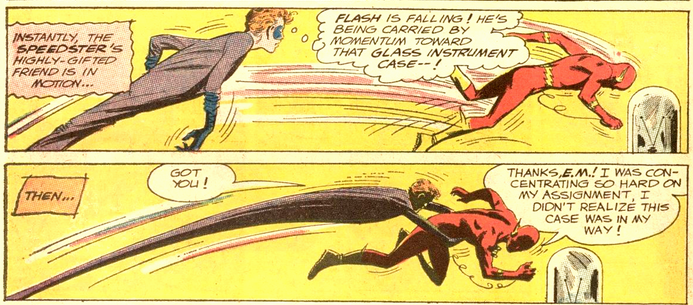
The two superheroes go to check out Lical and the error is reported to them. Barry attempts a test to see if he can spot any errors with the electric pulse since he can actually keep up with it. However, he loses balances and nearly falls into a glass case, but Ralph springs into action and saves him. Aside from this mishap, Barry can't detect an error.
These pages where Ralph and Barry inspect Lical are well-done with Infantino's use of shading to imply limited light sources and an indoor locale.
Heading back out in the car, Ralph and Barry hear about a mass escape from the state prison and decide to go hunt down the escapees.
The panel where Ralph gets a newspaper is oddly without dialogue when compared to all the other pages. It's the only panel without a narration box or dialogue. There's quite a bit of mainly empty space in the lower right corner, so I wonder if there's a missing word balloon where Ralph tells the newsboy that he'll take a paper. If this is the case, it's never been corrected.
Ralph and Barry set out to use their own techniques to round up the thirty escaped convicts.
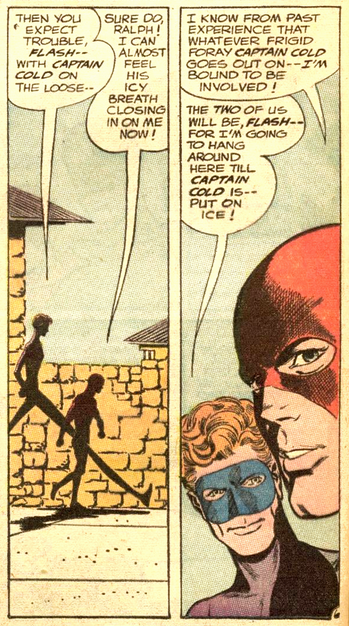
Barry and Ralph manage to capture all of the convicts except one: Leonard Snart, a.k.a. Captain Cold. The two heroes stroll out in what should be an iconic pose for the duo, though it's mainly in silhouette. Ralph says he's going to stick around.
Take a look at Ralph's dialogue here: "The two of us will be, Flash—for I'm going to hang around here till Captain Cold is—put on ice!" He takes a pause to make a pun. That's our Ralph.
Noting the repairs to the prison wall, Barry reflects that it was pure luck that caused the earthquake that allowed Snart to escape. We then cut over to a cave outside Central City where Snart is congratulating himself for causing the earthquake with "ultra-cold." How on earth he made that happen in prison is anyone's guess.
At the bottom of page 7, we see Barry and Iris West on a dinner date, Iris eager to tell Barry about what she was doing, but Barry's thoughts appear and we don't see Iris say what she was doing. I'm interpreting this as Barry getting lost in his thoughts and missing what she said. Rude, Barry. Rude. Well, until the next page where she reveals that she got to visit Snart's cell and noted that he seemed to be obsessed with a dancer named Miss Twist when he'd previously approached her for romantic intentions.
Overhearing that Captain Cold is in midtown, Barry convinces Iris to go see him, intending to dash out himself. I hope he made arrangements to pay for dinner. Barry finds Snart at a subdivision of the US mint, where he's just frozen the guards and prepares to make off with a lot of cash. Snart manages to distract Barry with a mirage from his cold gun as seen in the splash panel.
Seriously, Barry, did you slow down? You're moving at super speed. He shouldn't have time to see you're there and use his gun before you can catch him.
Running outside, Barry almost apprehends Snart before Ralph grabs him instead by accident, knocking him down. He doesn't know why he did it, but Barry assures him that they'll catch him. After catching up to Snart again, Barry gets frozen with "absolute zero," but manages to free himself with "vibration at super-speed." And yes, seems this bit serves as the basis for the title of the story.
As Ralph makes another grab for Snart, he again grabs Barry, making Snart so smug, he throws away his ice gun, and yep, here's the panel Infantino redrew as the cover. The composition is nearly the same, with things a bit more detailed and striking on the cover.
Whatever is going wrong with Ralph, it causes him to pick up Cold's gun and fire at Barry. Barry manages to out-maneuver him and finally has to knock out Ralph and then whirls Captain Cold back to jail.
Helping Ralph recover, Barry is reminded of Lical and drags Ralph back to the college campus, where he realizes some of the tubes in Lical are giving off a strange violet glow. Once the tubes are replaced, Lical begins working correctly. It seems that the odd radiation had affected Ralph as well due to his molecules being "vulnerable" because of his elasticity.
Well, looks like Barry has stopped using his car everywhere now. Also, the explanation of why the radiation affected Ralph reeks of bull. If anything, elastic molecules should bounce back, not absorb.
So, everything's peachy keen for Ralph and Barry, and apparently Sue, who it seems the creative team has completely forgotten about.
So, Ralph goes up against Captain Cold, is exposed to an odd weakness, and also, the defining moment of him not having a secret identity is right here, although it could easily have been an editorial afterthought. This story would've been better before Ralph's marriage to Sue.
The story is a rather weak team up story because we get a random "nerfing" of Ralph and Barry to make the story have any stakes. There's details about Captain Cold established in the story that wind up going nowhere. His interest in Miss Twist is why he commits the robbery of the subdivision of the mint. Speaking of which, are those people okay? We don't hear a thing about them. Realistically, no, those people are dead. Comic book science... maybe they survived once they thawed out.
In any case, next issue, Ralph's last appearance in The Flash for a long, long time.
The front cover throws us for a loop, looking as if Ralph is somehow in cahoots with Captain Cold, capturing the Flash. In fact, the smug Captain Cold is so confident, he throws his cold gun away as he runs. If you missed Ralph's previous appearances, it might make Ralph seem to be one of the rogues.
The detail on the cover is very good, despite no background beyond the sidewalk. This art is so lively.
The splash panel depicts a scene late in the story in which Captain Cold creates a mirage with his cold gun to slow down Barry. The difference between the splash panel and the point in the story is that the splash panel puts the scene outside. In the story, it's inside.
The story finds some scientists working on a supercomputer called a "lightning calculator" or "Lical," which has been giving the wrong answers to questions they feed to it.
And here we find Barry and Ralph casually riding in a car together at the campus where they're about to check out Lical. No sign or mention of Sue. However, we do get an asterisk informing us that Ralph's identity has been revealed to the world, although the wording is a little off. If you thought Ralph's secret identity (such as it was, thanks, Barry) being revealed would be a big story, think again. There's a reason why I'm glad that The Flash TV show is giving Ralph character arcs: he needed a revamp that did something like that.
I do love the way Infantino draws Ralph's elongated neck. It already tells you he likes to show off.
Wait, is this Barry's car? If it was one of the cars Ralph and Sue use (I'm theorizing that they rent), why isn't Ralph driving? The problem is, I doubt he has that car licensed to "the Flash," thus meaning all someone has to do is take down his license plate number and look it up, and they know who the Flash actually is. What the heck, Barry?
These pages where Ralph and Barry inspect Lical are well-done with Infantino's use of shading to imply limited light sources and an indoor locale.
Heading back out in the car, Ralph and Barry hear about a mass escape from the state prison and decide to go hunt down the escapees.
The panel where Ralph gets a newspaper is oddly without dialogue when compared to all the other pages. It's the only panel without a narration box or dialogue. There's quite a bit of mainly empty space in the lower right corner, so I wonder if there's a missing word balloon where Ralph tells the newsboy that he'll take a paper. If this is the case, it's never been corrected.
Ralph and Barry set out to use their own techniques to round up the thirty escaped convicts.
Take a look at Ralph's dialogue here: "The two of us will be, Flash—for I'm going to hang around here till Captain Cold is—put on ice!" He takes a pause to make a pun. That's our Ralph.
Noting the repairs to the prison wall, Barry reflects that it was pure luck that caused the earthquake that allowed Snart to escape. We then cut over to a cave outside Central City where Snart is congratulating himself for causing the earthquake with "ultra-cold." How on earth he made that happen in prison is anyone's guess.
At the bottom of page 7, we see Barry and Iris West on a dinner date, Iris eager to tell Barry about what she was doing, but Barry's thoughts appear and we don't see Iris say what she was doing. I'm interpreting this as Barry getting lost in his thoughts and missing what she said. Rude, Barry. Rude. Well, until the next page where she reveals that she got to visit Snart's cell and noted that he seemed to be obsessed with a dancer named Miss Twist when he'd previously approached her for romantic intentions.
Overhearing that Captain Cold is in midtown, Barry convinces Iris to go see him, intending to dash out himself. I hope he made arrangements to pay for dinner. Barry finds Snart at a subdivision of the US mint, where he's just frozen the guards and prepares to make off with a lot of cash. Snart manages to distract Barry with a mirage from his cold gun as seen in the splash panel.
Seriously, Barry, did you slow down? You're moving at super speed. He shouldn't have time to see you're there and use his gun before you can catch him.
Running outside, Barry almost apprehends Snart before Ralph grabs him instead by accident, knocking him down. He doesn't know why he did it, but Barry assures him that they'll catch him. After catching up to Snart again, Barry gets frozen with "absolute zero," but manages to free himself with "vibration at super-speed." And yes, seems this bit serves as the basis for the title of the story.
As Ralph makes another grab for Snart, he again grabs Barry, making Snart so smug, he throws away his ice gun, and yep, here's the panel Infantino redrew as the cover. The composition is nearly the same, with things a bit more detailed and striking on the cover.
Whatever is going wrong with Ralph, it causes him to pick up Cold's gun and fire at Barry. Barry manages to out-maneuver him and finally has to knock out Ralph and then whirls Captain Cold back to jail.
Helping Ralph recover, Barry is reminded of Lical and drags Ralph back to the college campus, where he realizes some of the tubes in Lical are giving off a strange violet glow. Once the tubes are replaced, Lical begins working correctly. It seems that the odd radiation had affected Ralph as well due to his molecules being "vulnerable" because of his elasticity.
Well, looks like Barry has stopped using his car everywhere now. Also, the explanation of why the radiation affected Ralph reeks of bull. If anything, elastic molecules should bounce back, not absorb.
So, everything's peachy keen for Ralph and Barry, and apparently Sue, who it seems the creative team has completely forgotten about.
So, Ralph goes up against Captain Cold, is exposed to an odd weakness, and also, the defining moment of him not having a secret identity is right here, although it could easily have been an editorial afterthought. This story would've been better before Ralph's marriage to Sue.
The story is a rather weak team up story because we get a random "nerfing" of Ralph and Barry to make the story have any stakes. There's details about Captain Cold established in the story that wind up going nowhere. His interest in Miss Twist is why he commits the robbery of the subdivision of the mint. Speaking of which, are those people okay? We don't hear a thing about them. Realistically, no, those people are dead. Comic book science... maybe they survived once they thawed out.
In any case, next issue, Ralph's last appearance in The Flash for a long, long time.
Kid Flash Meets The Elongated Man!
This story comes from The Flash #130. John Broome is writing again, Carmine Infantino is back on the art, and Julius Schwartz editing.
So, we have the first time Ralph meets young Wally West, Kid Flash, and post-Crisis on Infinite Earths, he became the Flash after Barry died while making a strike against the Anti-Monitor. This is before Kid Flash had his own unique costume.
This splash page does something unusual by showing us the main characters twice. The lower part shows a moment from the climax of the story, while up above, we get decorative illustrations of the characters around the title and a teaser.
The lower part of the splash page amuses me because that is a HUGE block of dialogue that Ralph is rambling off as he moves quickly. Infantino draws it nice and dramatic here, although you'll notice Wally's costume is lacking the circle behind the thunderbolt on the chest.
The story starts with Barry arriving in Wally's room at his home in Blue Valley, and the art makes it look like Barry is spinning at super speed. He makes Wally close the window blinds so no one sees him. Maybe you could have done that at super speed first, Barry, just saying. Would've looked cooler.
Barry tells Wally that Ralph Dibny sent a letter to the Flash at the Central City Police Department asking for his help in investigating a "situation." Barry is about to vacation with Iris, so he sends Wally because he can't spare a moment away from his woman.
Okay, can our superheroes not work out a better way to communicate than just letters?
Wally agrees, eager to meet Ralph and become friends, so he hurries to Ralph's location.
Ralph (Sue is nowhere to be seen) explains that Oakley County is inaccessible due to the roads being blocked by extreme winter weather. Not even planes can get through due to heavy clouds. Ralph and Wally head out, and the use of outdoor scenes only on the rest of the page can get a little confusing. Also, Ralph's car is seemingly the only car at the motel, so maybe this bad weather has really badly affected the economy of the area.
Here we have Ralph and Wally making their way through the ice and snow wearing only their superhero costumes. I really hope for their sake that those costumes are well-insulated.
Infantino is doing good work with the winter landscape here, especially this ravine that Ralph helps Wally cross. He shows you how deep it is, and how resourceful the two are. So you get the idea that they're well-matched to what they'd come across.
Aside from the splash page, this is the point of the story where it is confirmed that the Weather Wizard is behind the extreme weather. He's making the people of Goldville (the main town of Oakley County) pay him before he'll stop the extreme weather, seeking a payout of $100,000. The townsfolk are beginning to break.
The comic cuts to some excellently drawn panels of Weather Wizard, who reveals to the reader that his plan is to use the money to build an even bigger weather station. And to supplement the ransom money, he's having a few assistants robbing the local bank.
Having split ways with Wally, Ralph runs into Goldville and spots the bank robbers. Noting hail falling directly out of the way of the robbers but blocking the way of the bank guard. However, Ralph springs directly into action, stretching in a long arc to grab one of the thieves.
Infantino excellently draws snow and hail, but again, I really hope his costume is helping him fend off the cold, and he must have some good traction on those shoes to be running like that on the snow.
The captured henchman squeals that the Weather Wizard is behind this, making Ralph hurry to the hideout, where Wally has been heading.
More great art from Infantino, on the next panel (which I didn't show), he draws a little brown rabbit hopping around in the snow.
Wally notices a big reflector on the shack, then hurries in and finds Weather Wizard, who manages to take him out with a flash of light and a smoke bomb that masks him punching him in the back of the head. Wow, it's almost as if Wally didn't have super speed.
Ralph has reached the cabin and manages to spot that Weather Wizard has taken out Wally. He slips in, but Weather Wizard is ready for him and uses a "lightning bolt device" that stops Ralph's "circulation" which paralyzes him.
Um, pretty sure that if you stop someone's circulation, they die.
Wally revives and "vibrates" at super speed in an attempt to save Ralph. I mean, to be fair, maybe Ralph is dying here.
I looks more like Wally is moving Ralph at super speed than just "vibrating." But I guess he has to move so Weather Wizard can't get them again.
I am going to save my comments on these pages' story for the end...
Ralph's circulation is restored and he manages to knock out Weather Wizard. The criminals are all thrown in jail, the weather controlling mechanisms are destroyed, and the snow finally melts across Oakley County as the two heroes head home.
Well, it's one of those Silver Age stories that has points that don't really hold up to actual scientific scrutiny. But that's just about standard for any Silver Age story.
The bigger issue is that aside from that bit to getting to Goldville, there's really no reason why Wally needed Ralph's help. No reason why Weather Wizard should've been able to knock him out. Basically, both characters get "nerfed" (or having their power reduced) in order to justify a team up, which is one of the negative tropes of team up stories of this era.
So, it's cool that we see Ralph meet Wally, a friendship that'll come up quite a bit in the future, but the two really deserved a more solid team up.
So, we have the first time Ralph meets young Wally West, Kid Flash, and post-Crisis on Infinite Earths, he became the Flash after Barry died while making a strike against the Anti-Monitor. This is before Kid Flash had his own unique costume.
This splash page does something unusual by showing us the main characters twice. The lower part shows a moment from the climax of the story, while up above, we get decorative illustrations of the characters around the title and a teaser.
The lower part of the splash page amuses me because that is a HUGE block of dialogue that Ralph is rambling off as he moves quickly. Infantino draws it nice and dramatic here, although you'll notice Wally's costume is lacking the circle behind the thunderbolt on the chest.
The story starts with Barry arriving in Wally's room at his home in Blue Valley, and the art makes it look like Barry is spinning at super speed. He makes Wally close the window blinds so no one sees him. Maybe you could have done that at super speed first, Barry, just saying. Would've looked cooler.
Barry tells Wally that Ralph Dibny sent a letter to the Flash at the Central City Police Department asking for his help in investigating a "situation." Barry is about to vacation with Iris, so he sends Wally because he can't spare a moment away from his woman.
Okay, can our superheroes not work out a better way to communicate than just letters?
Wally agrees, eager to meet Ralph and become friends, so he hurries to Ralph's location.
Ralph (Sue is nowhere to be seen) explains that Oakley County is inaccessible due to the roads being blocked by extreme winter weather. Not even planes can get through due to heavy clouds. Ralph and Wally head out, and the use of outdoor scenes only on the rest of the page can get a little confusing. Also, Ralph's car is seemingly the only car at the motel, so maybe this bad weather has really badly affected the economy of the area.
Here we have Ralph and Wally making their way through the ice and snow wearing only their superhero costumes. I really hope for their sake that those costumes are well-insulated.
Infantino is doing good work with the winter landscape here, especially this ravine that Ralph helps Wally cross. He shows you how deep it is, and how resourceful the two are. So you get the idea that they're well-matched to what they'd come across.
Aside from the splash page, this is the point of the story where it is confirmed that the Weather Wizard is behind the extreme weather. He's making the people of Goldville (the main town of Oakley County) pay him before he'll stop the extreme weather, seeking a payout of $100,000. The townsfolk are beginning to break.
The comic cuts to some excellently drawn panels of Weather Wizard, who reveals to the reader that his plan is to use the money to build an even bigger weather station. And to supplement the ransom money, he's having a few assistants robbing the local bank.
Having split ways with Wally, Ralph runs into Goldville and spots the bank robbers. Noting hail falling directly out of the way of the robbers but blocking the way of the bank guard. However, Ralph springs directly into action, stretching in a long arc to grab one of the thieves.
Infantino excellently draws snow and hail, but again, I really hope his costume is helping him fend off the cold, and he must have some good traction on those shoes to be running like that on the snow.
The captured henchman squeals that the Weather Wizard is behind this, making Ralph hurry to the hideout, where Wally has been heading.
More great art from Infantino, on the next panel (which I didn't show), he draws a little brown rabbit hopping around in the snow.
Wally notices a big reflector on the shack, then hurries in and finds Weather Wizard, who manages to take him out with a flash of light and a smoke bomb that masks him punching him in the back of the head. Wow, it's almost as if Wally didn't have super speed.
Ralph has reached the cabin and manages to spot that Weather Wizard has taken out Wally. He slips in, but Weather Wizard is ready for him and uses a "lightning bolt device" that stops Ralph's "circulation" which paralyzes him.
Um, pretty sure that if you stop someone's circulation, they die.
Wally revives and "vibrates" at super speed in an attempt to save Ralph. I mean, to be fair, maybe Ralph is dying here.
I looks more like Wally is moving Ralph at super speed than just "vibrating." But I guess he has to move so Weather Wizard can't get them again.
I am going to save my comments on these pages' story for the end...
Ralph's circulation is restored and he manages to knock out Weather Wizard. The criminals are all thrown in jail, the weather controlling mechanisms are destroyed, and the snow finally melts across Oakley County as the two heroes head home.
Well, it's one of those Silver Age stories that has points that don't really hold up to actual scientific scrutiny. But that's just about standard for any Silver Age story.
The bigger issue is that aside from that bit to getting to Goldville, there's really no reason why Wally needed Ralph's help. No reason why Weather Wizard should've been able to knock him out. Basically, both characters get "nerfed" (or having their power reduced) in order to justify a team up, which is one of the negative tropes of team up stories of this era.
So, it's cool that we see Ralph meet Wally, a friendship that'll come up quite a bit in the future, but the two really deserved a more solid team up.
Who is John Broome?
So, I keep bringing up their names when talking about the comics, who are some of the men responsible for creating the Elongated Man comics?
Irving Broome was born on May 4, 1913 to a Jewish family and grew up enjoying science fiction. In the 1940s, he had already begun a writing career of his own. His first published work was a two-page "Pals and Pastimes" spread in Funny Pages #7, published in 1936.
This began his writing for comics career. Eventually, he was working for Fawcett, writing text pages for their comics, using a variety of pseudonyms. It was at Fawcett that he met Julius Schwartz, who would move to All-American Publications and managed to get Broome over as well. All-American would eventually be merged into National Publications, which was soon nicknamed DC Comics, and later officially took that name.
Broome worked on many stories for the original incarnations of the Flash and the Green Lantern. He kept up a varied output, and created many minor characters for DC. When DC decided to revive superhero brands in the mid to late 1950s, Broome was the one to write the first stories featuring Barry Allen and Hal Jordan, the new Flash and Green Lantern, these new versions varying wildly from the original versions, becoming the iconic incarnations of these heroes.
After establishing new heroes and characters in the early 60s, Broome and artist Carmine Infantino would revamp none other than Batman, giving him a new look, removing many of the sillier additions to Batman lore, and focusing the stories in Detective Comics on mysteries. Their first issue of Detective Comics with the new Batman was #327, which also saw the Elongated Man appear as a solo backup feature. Broome would continue at DC until 1970.
By the time of his retirement, Broome was sending his scripts to DC from his new home in Paris, France. He and his wife Peggy later moved to Japan to teach English. Broome died in 1999, vacationing in Thailand while swimming in his hotel's pool with his wife.
Thanks to John Broome for offering his talent to DC Comics as they revived themselves in the Silver Age. He helped create Ralph Dibny, and many of the properties he helped establish we still love and enjoy today.
Even though sometimes his plot devices were downright weird. But hey, that's part of what I love about these comics.
Irving Broome was born on May 4, 1913 to a Jewish family and grew up enjoying science fiction. In the 1940s, he had already begun a writing career of his own. His first published work was a two-page "Pals and Pastimes" spread in Funny Pages #7, published in 1936.
This began his writing for comics career. Eventually, he was working for Fawcett, writing text pages for their comics, using a variety of pseudonyms. It was at Fawcett that he met Julius Schwartz, who would move to All-American Publications and managed to get Broome over as well. All-American would eventually be merged into National Publications, which was soon nicknamed DC Comics, and later officially took that name.
After establishing new heroes and characters in the early 60s, Broome and artist Carmine Infantino would revamp none other than Batman, giving him a new look, removing many of the sillier additions to Batman lore, and focusing the stories in Detective Comics on mysteries. Their first issue of Detective Comics with the new Batman was #327, which also saw the Elongated Man appear as a solo backup feature. Broome would continue at DC until 1970.
By the time of his retirement, Broome was sending his scripts to DC from his new home in Paris, France. He and his wife Peggy later moved to Japan to teach English. Broome died in 1999, vacationing in Thailand while swimming in his hotel's pool with his wife.
Thanks to John Broome for offering his talent to DC Comics as they revived themselves in the Silver Age. He helped create Ralph Dibny, and many of the properties he helped establish we still love and enjoy today.
Even though sometimes his plot devices were downright weird. But hey, that's part of what I love about these comics.
Subscribe to:
Posts (Atom)
Where Ralph could fit in James Gunn's DCU (and Plastic Man too!)
So, hi! I haven't forgotten about this blog, it's just time gets away from me, there's other stuff I want to handle. If I could...
-
Well, I ran out of time to do another comic breakdown this week, so here's something different. I Photoshopped Hartley Sawyer—who will...
-
"Before you read this, remind me to tell you the difference between Plastic Man and Elongated Man." — Seth Cohen, The O.C. The...
-
So, hi! I haven't forgotten about this blog, it's just time gets away from me, there's other stuff I want to handle. If I could...